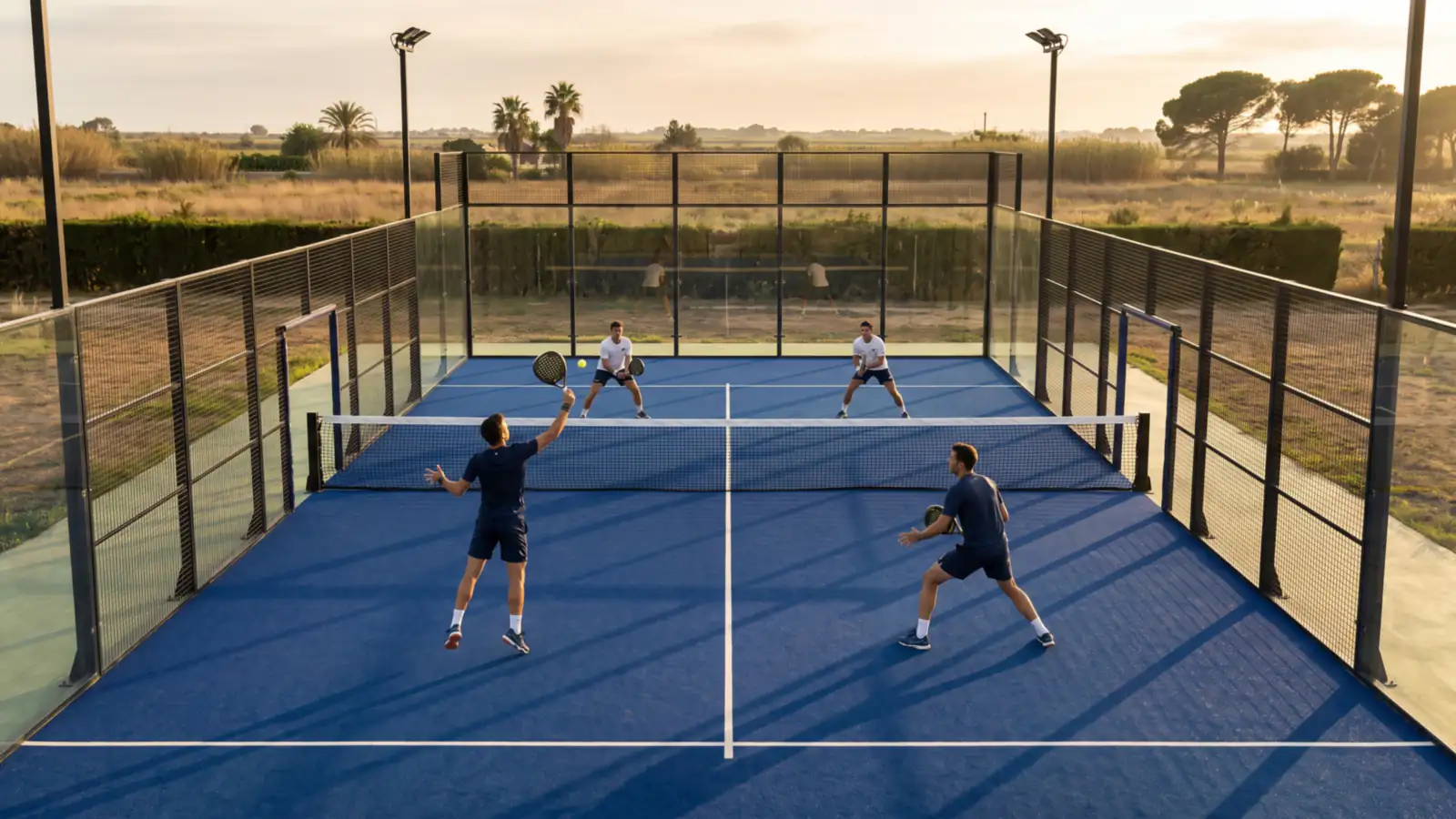
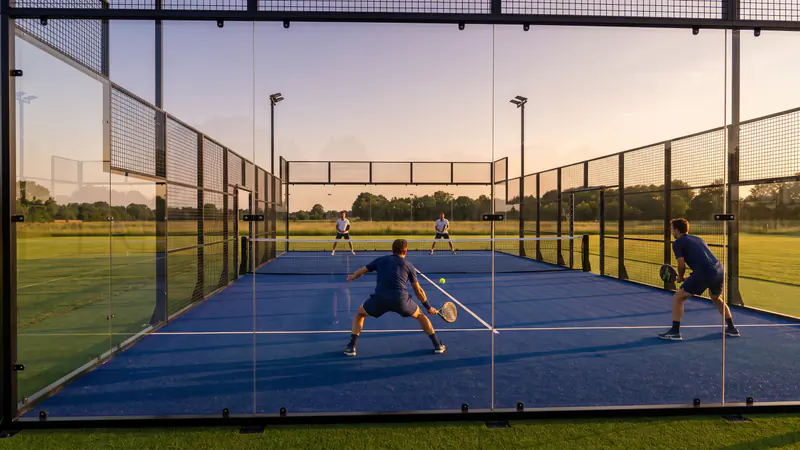
Court, serve, walls and scoring – everything you need to know for your first match.
By the PadelLeague editorial team · Checked on October 2, 2026 against the rulebook of the world federation FIP
Padel in 30 seconds
Padel is a racket sport played almost always in doubles, on a 20 × 10 metre court enclosed by glass walls. You serve underhand and score like tennis (15, 30, 40, game). The ball has to bounce in the opponents' half before it touches a wall – after that it may rebound off the walls and stays in play.
What is padel?
Padel was invented in Mexico in 1969 and had its first big boom in Argentina, which is still one of the strongest padel nations today. Now the sport is popular above all in South America, Spain, Italy, Sweden and increasingly in Germany. It is played with a solid, perforated racket without strings and a ball that looks like a tennis ball but has slightly less pressure. Because the court is small and the walls are part of the game, rallies are long and it is easy to get started: real rallies happen in the very first hour.
How big is a padel court?
A padel court is 20 metres long and 10 metres wide, split into two halves by a net. The net is 88 centimetres high in the middle and 92 centimetres at the posts. Behind the baselines are glass walls; the sides have glass and metal mesh. The service line lies just under seven metres from the net and, together with the centre line, forms two service boxes on each side. Narrower 6-metre courts exist for singles.
Glass wallMetal meshNet
How do you serve in padel?
The serve is played underhand: you bounce the ball once behind the service line and hit it at or below waist height. It must land diagonally in the opposite service box. After bouncing it may touch the glass wall but not the metal mesh – that is a fault. Each player gets two attempts. If the ball clips the net and still lands in the right box, the serve is replayed. The receiver must let the ball bounce once before returning it.
How do you play off the walls?
Every shot must first bounce in the opponents' half. Only after that may the ball hit glass or mesh, and the opponents may still play it after the rebound – as long as it has not touched the ground a second time. If your shot hits the opponents' wall directly without bouncing first, you lose the point. You may also hit the ball against your own glass wall so that it travels over the net from there. Volleys are allowed, except when returning the serve.
How do you score in padel?
Scoring works like tennis: 15, 30, 40, game. A set goes to the team that first wins six games with a two-game lead; at 6–6 a tiebreak decides. A match is usually best of three sets. Many tournaments and casual sessions replace advantage at 40–40 with a single deciding point, the golden point: the receiving team chooses the side, and whoever wins it wins the game. In formats such as Americano you count points instead of sets.
When do you lose a point?
The ball bounces twice on your side before you play it.
Your shot hits the opponents' wall or mesh without bouncing in their half first.
Your shot goes into the net or straight out.
The ball hits you or your partner.
You touch the net during the rally – with your body or your racket.
On serve: two missed attempts in a row (double fault).
How is padel different from tennis?
Padel is played on a much smaller court enclosed by walls, almost always with four players. The serve is underhand, the racket has no strings, and the walls are part of the game. Placement and patience therefore count for more than power – and beginners get to long rallies much faster than in tennis.
Frequently asked questions
How many players do you need for padel?
Padel is almost always played as doubles, two against two. Singles is possible but only common on special, narrower courts.
Can you volley the return of serve?
No. The return must be played after one bounce. Later in the rally, volleys are allowed.
What is the golden point?
With the golden point there is no advantage at 40–40: a single point decides the game, and the receiving team chooses which side the serve goes to.
Can you play the ball after it rebounds off the mesh?
Yes. If the ball has bounced in the court first, it stays in play after rebounding off glass or mesh. Only on the serve is hitting the mesh after the bounce a fault.
Which racket do I need to start?
A round, rather soft racket that forgives mistakes is enough to start. Many clubs rent out rackets and balls for your first hour.
Ready for your first match? Find a padel club near you.