

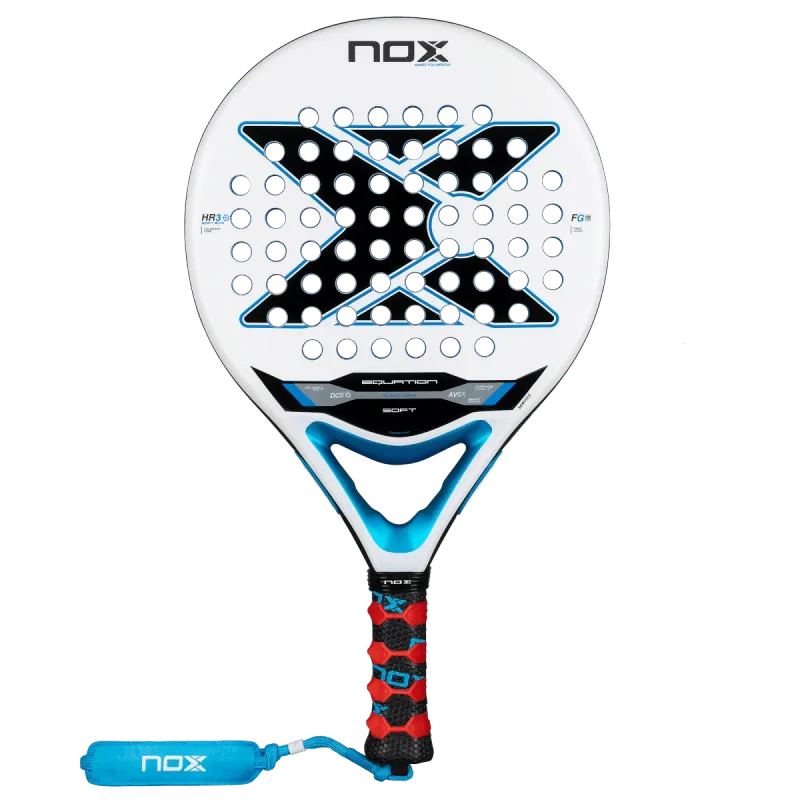
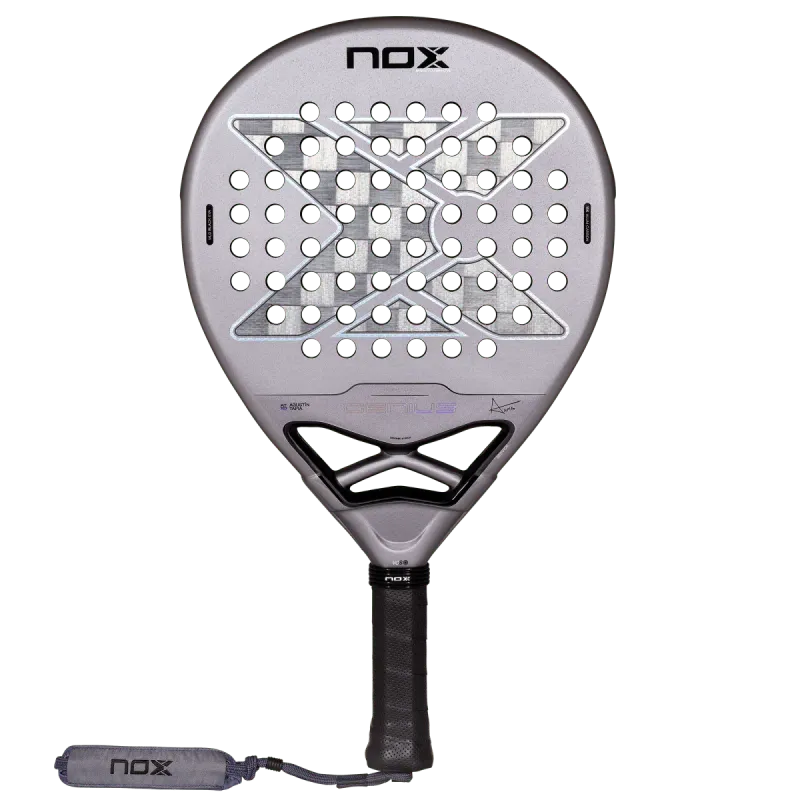
The NOX Equation Soft Advanced is best suited for intermediate players who want high forgiveness, soft feel, and arm comfort during defensive play. In contrast, the NOX Genius 18K Alum Agustín Tapia 2027 targets pro-level players looking for a balanced teardrop racket capable of supporting an all-round game style. Choosing between them comes down to whether you prefer a forgiving control-oriented setup or a firmer carbon structure for versatile transitions.
| Feature | NOX Equation Soft Advanced | NOX Genius 18K Alum Agustín Tapia 2027 |
|---|---|---|
| Target Level (Manufacturer) | Intermediate | Pro |
| Racket Shape | Round | Teardrop |
| Weight | 360–375 g | 360–375 g |
| Profile Thickness | Not stated | 38 mm |
| Face Construction | Fiber Glass 3K | Carbon Fiber 18K Alum |
| Frame Construction | Not stated | Carbon |
| Core Material | Not stated | MLD Black Eva |
| Model Season | Not stated | 2027 |
| Core Hardness (our assessment) | Soft | Medium |
| Power vs Control (our assessment) | 2/5 (Control focus) | 3/5 (Balanced) |
| Sweet Spot Size (our assessment) | Large | Medium |
| Recommended Player Types (our assessment) | Builder, Counter | Allrounder, Builder |
Which racket offers better control and sweet spot size?
When defending off the glass or counter-punching in slow rallies, sweet spot size and core softness dictate how easily you can reset the point. The NOX Equation Soft Advanced features a round shape and, in our assessment, a large sweet spot combined with a soft core. We rate its power versus control balance at 2 out of 5, placing it clearly on the control-focused side of the spectrum. This makes it particularly forgiving when hit off-center, helping game builders remain patient from the backcourt.
On the other hand, the NOX Genius 18K Alum Agustín Tapia 2027 uses a teardrop shape. In our assessment, it provides a medium sweet spot and a medium core hardness, yielding a 3 out of 5 power versus control rating. While it offers less passive forgiveness than the round model, it provides a more consistent baseline for players who hit cleanly and want precise feedback when redirecting heavy shots.
Which one provides more output and versatility at the net?
At the net, player requirements shift toward shot execution like bandejas, viboras, and overhead smashes. The NOX Genius 18K Alum Agustín Tapia 2027 is built with a Carbon Fiber 18K Alum face, a Carbon frame, and an MLD Black Eva core with a 38 mm profile. Combined with its teardrop geometry, this construction allows allrounders to generate balanced power when pressing the attack. In our assessment, its medium core hardness offers the structural response needed for decisive volleying and controlled overhead placement.
The NOX Equation Soft Advanced offers lower raw power due to its Fiber Glass 3K face and round head shape. Because we rate its power output at 2 out of 5, players relying on explosive smashes might find it lacks top-end force. However, for defensive counters and tactical placement near the net, its softer feel helps absorb incoming pace and drop balls short into space.
How do their materials affect feel and comfort?
Material selection directly impacts playing comfort and court feedback. The manufacturer specifies a Fiber Glass 3K face for the NOX Equation Soft Advanced, while frame and core details are not stated. Paired with what we rate as a soft core, this racket dampens vibrations effectively during longer matches. Players prone to arm fatigue or those still developing technical consistency will appreciate the soft impact feel.
The NOX Genius 18K Alum Agustín Tapia 2027 features carbon materials, including an 18K Alum carbon fiber face and a carbon frame, paired with an MLD Black Eva core. In our assessment, this configuration results in a medium core hardness that feels noticeably firmer upon ball contact. While it provides excellent directional accuracy and energy transfer for advanced players, it offers less cushioning than its fiberglass counterpart.
Who should buy which?
NOX Equation Soft Advanced
- Intermediate players looking for an easy-to-play, forgiving racket.
- Defensive counter-players and point builders who prioritize court positioning and lob accuracy.
- Players who prefer a soft core feel and large sweet spot for maximum comfort.
NOX Genius 18K Alum Agustín Tapia 2027
- Pro-level players requiring high precision across all areas of the court.
- All-round and building players who frequently transition between defense and net play.
- Players looking for a balanced teardrop shape with a medium core feel and structured carbon materials.
Frequently asked questions
What is the power versus control rating for each racket?
In our assessment, the NOX Equation Soft Advanced receives a power versus control rating of 2 out of 5 (focusing on control), whereas the NOX Genius 18K Alum Agustín Tapia 2027 receives a rating of 3 out of 5 (balanced performance).
Which player levels are these rackets designed for?
According to manufacturer specifications, the NOX Equation Soft Advanced is designed for intermediate players, while the NOX Genius 18K Alum Agustín Tapia 2027 is built for pro-level players.
What are the main frame and core material differences?
The manufacturer states that the NOX Genius 18K Alum Agustín Tapia 2027 features a Carbon frame and an MLD Black Eva core with an 18K Alum Carbon Fiber face. For the NOX Equation Soft Advanced, the face uses Fiber Glass 3K, while the specific frame and core materials are not stated.