

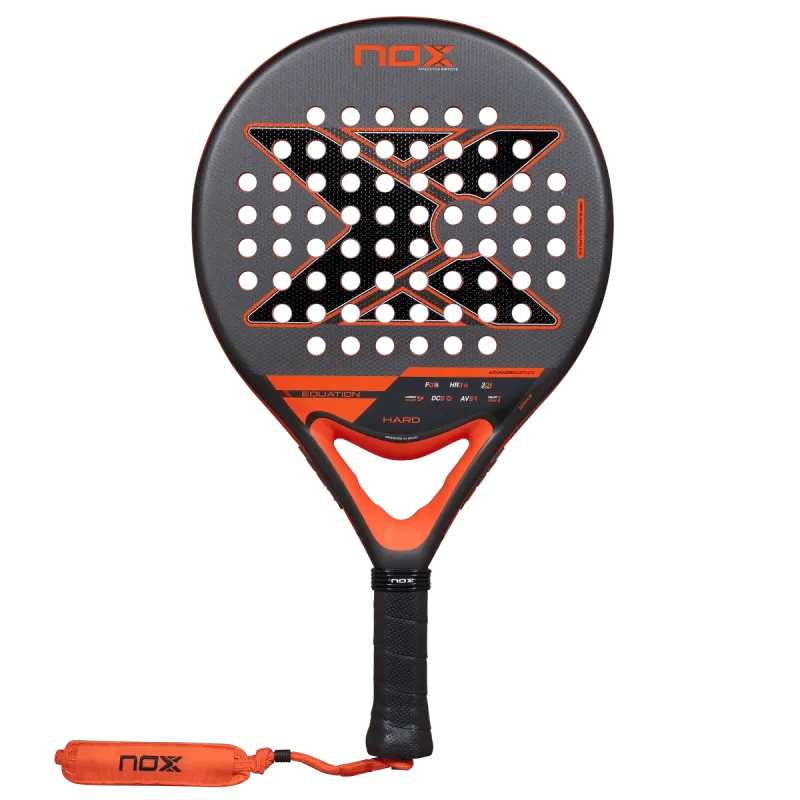
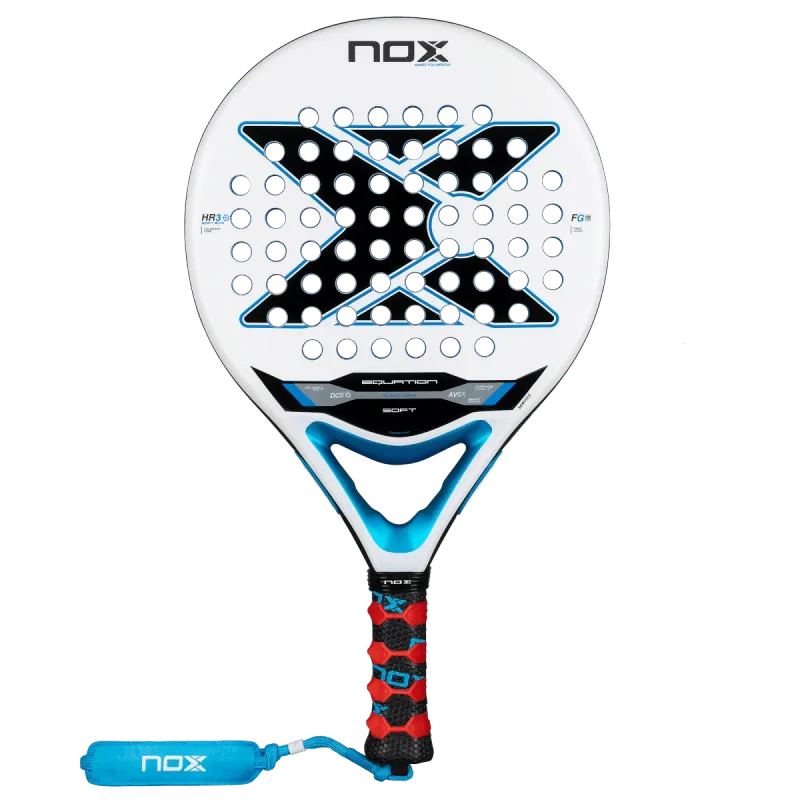
The NOX Equation Hard Advanced 2027 suits intermediate point-builders and counter-players who prefer a round shape paired with a firm impact feel for balanced directness on court. Meanwhile, the NOX Equation Soft Advanced is best suited for intermediate players seeking a softer impact profile focused on comfort and defensive control. Both rackets share round geometry and a large sweet spot in our assessment, but their underlying core density and weight specs target slightly different player preferences.
| Feature | NOX Equation Hard Advanced 2027 | NOX Equation Soft Advanced |
|---|---|---|
| Target Level | Intermediate | Intermediate |
| Shape | Round | Round |
| Weight | 355–365 g | 360–375 g |
| Profile Thickness | 38 mm | Not stated |
| Face Material | 3K Fiberglass | Fiber Glass 3K |
| Frame Material | Carbon | Not stated |
| Core Material | HR3 HARD EVA | Not stated |
| Season | 2027 | Not stated |
| Core Hardness (our assessment) | Hard | Soft |
| Power vs Control (our assessment) | 3 (Scale 1–5) | 2 (Scale 1–5) |
| Sweet Spot Size (our assessment) | Large | Large |
| Player Types (our assessment) | Builder, Counter | Builder, Counter |
Which one has more power?
When evaluating offensive output, core hardness plays a significant role in how energy transfers to the ball during overhead shots such as smashes or aggressive viboras. In our assessment, we rate the NOX Equation Hard Advanced 2027 at a 3 on our 1 to 5 power-versus-control scale (where 1 represents pure control and 5 represents pure power). The hard core density, combined with the manufacturer-specified HR3 HARD EVA core and carbon frame, gives this racket a more rigid response. This rigidity helps players generate direct pace when driving the ball down the line or punching aggressive volleys at the net.
In contrast, we rate the NOX Equation Soft Advanced at a 2 on our 1 to 5 power-versus-control scale. In our assessment, its soft core hardness absorbs more of the ball's incoming momentum. While this dampening effect helps cushion fast shots, it requires more physical effort from the player to generate high finishing speed on power shots. However, the Soft Advanced carries a manufacturer weight specification of 360–375 g, which is slightly heavier than the Hard Advanced 2027 (355–365 g), providing a touch of mass behind the ball despite the softer feel.
Which is easier to play and control?
Control and playability depend on how forgiving a racket feels during fast rallies, particularly when defending off the glass or hitting delicate drops at the net. Both rackets feature a round shape according to the manufacturer, and in our assessment, both offer a large sweet spot. This makes off-center hits manageable for intermediate players working on consistency.
The choice comes down to preferred feedback. The NOX Equation Soft Advanced excels in ease of play during defensive scenarios. The soft core (in our assessment) gives players extra cushion and dwell time, making it easier to control lob trajectory or play controlled chiquitas when under pressure in the back of the court.
Conversely, the NOX Equation Hard Advanced 2027 offers tighter precision. Because the core does not compress as deep, players who rely on touch and quick directional changes receive immediate feedback. This makes blocking heavy bandejas or positioning fast volleys at the net feel consistent, provided the player prefers a firm contact feel over arm-dampening cushion.
How do the specifications compare?
Looking at manufacturer details, both rackets use fiberglass faces—specifically listed as 3K Fiberglass on the Hard Advanced 2027 and Fiber Glass 3K on the Soft Advanced. Beyond the face material, the manufacturer specifications diverge in availability and detail.
The NOX Equation Hard Advanced 2027 is detailed with a 38 mm frame thickness, a carbon frame, an HR3 HARD EVA core, a weight of 355–365 g, and belongs to the 2027 season. For the NOX Equation Soft Advanced, the manufacturer specifies the round shape, intermediate player level, and a weight of 360–375 g; however, its frame material, core material, profile thickness, and release season are not stated.
In our assessment of key characteristics, the Hard Advanced 2027 features a hard core density, whereas the Soft Advanced features a soft core density. Both rackets share a large sweet spot and are assessed as suitable for builder and counter player types.
Who should buy which?
Choose the NOX Equation Hard Advanced 2027 if you:
- Are an intermediate player who prefers a 3 out of 5 power-versus-control balance (in our assessment).
- Want a firmer HR3 HARD EVA core paired with a carbon frame for crisp feedback on net volleys and bandejas.
- Prefer a slightly lighter weight range of 355–365 g for faster maneuvering.
- Play as a builder or counter-attacker who values direct ball output.
Choose the NOX Equation Soft Advanced if you:
- Are an intermediate player looking for a 2 out of 5 rating on our power-versus-control scale (in our assessment).
- Prefer a soft core hardness (in our assessment) for comfortable impact and defensive play off the glass.
- Value a slightly heavier weight range of 360–375 g for extra stability.
- Focus on tactical placement, lobbing, and point building from the back of the court.
Frequently asked questions
What player level are these NOX rackets designed for?
According to the manufacturer, both the NOX Equation Hard Advanced 2027 and the NOX Equation Soft Advanced are designed for intermediate padel players.
What is the main difference in core hardness between the two?
In our assessment, the NOX Equation Hard Advanced 2027 has a hard core hardness, utilizing an HR3 HARD EVA core (stated by the manufacturer). In our assessment, the NOX Equation Soft Advanced features a soft core hardness; its exact core material is not stated by the manufacturer.
How do the weights of these rackets compare?
The NOX Equation Hard Advanced 2027 has a manufacturer-specified weight of 355–365 g, making it slightly lighter than the NOX Equation Soft Advanced, which has a manufacturer-specified weight of 360–375 g.