

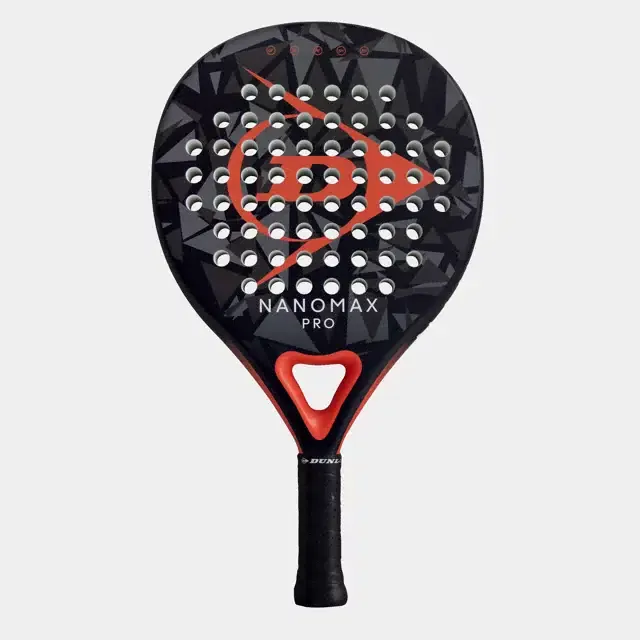
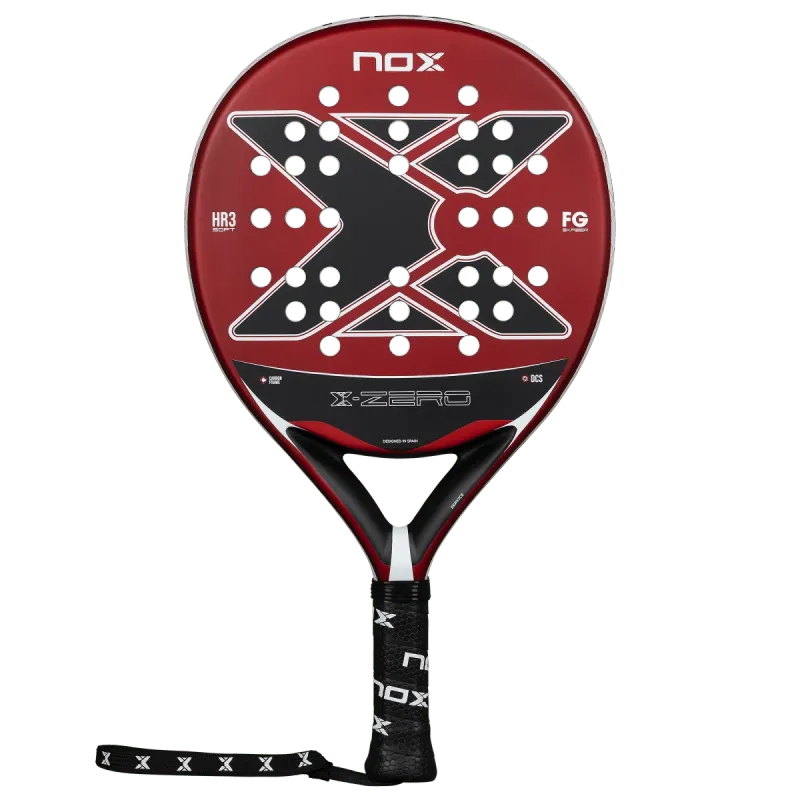
The Dunlop Nanomax Pro suits intermediate allrounders who need a balanced hybrid racket to transition smoothly between defense and attack across the court. The NOX X-Zero is built for beginner players, offering a lighter round frame designed for defensive builders and counter-punchers. Choosing between them depends on your experience level and whether you prefer an all-round hybrid or a forgiving, control-oriented setup.
| Feature | Dunlop Nanomax Pro | NOX X-Zero |
|---|---|---|
| Target Level (manufacturer) | Intermediate | Beginner |
| Shape | Hybrid (our assessment) | Round (manufacturer) |
| Weight (manufacturer) | 365 g | 350–360 g |
| Core Material (manufacturer) | Pro EVA | Not stated |
| Face Material (manufacturer) | Not stated | Fiber Glass 3K |
| Core Hardness (our assessment) | Medium (our assessment) | Not stated |
| Power vs Control (our assessment) | 3 / 5 (our assessment) | Not stated |
| Sweet Spot Size (our assessment) | Medium (our assessment) | Large (our assessment) |
| Ideal Player Type (our assessment) | Allrounder (our assessment) | Builder, Counter (our assessment) |
Which racket offers better control and maneuverability?
When defending deep behind the glass or resetting fast exchanges at the net, maneuverability and sweet spot forgiveness play crucial roles. The NOX X-Zero features a manufacturer-stated round shape paired with a weight range of 350–360 g. In our assessment, this setup provides a large sweet spot, making it particularly suitable for defensive builders and counter-players who prioritize consistency and quick positioning. The lower overall weight allows for swift wrist movement when returning low wall rebounds.
In contrast, the Dunlop Nanomax Pro weighs 365 g according to Dunlop. In our assessment, it features a hybrid shape with a medium sweet spot. While it requires slightly more deliberate technique when defending off the back glass, it provides a stable platform for tactical placement. In our assessment, players looking to build points from the back of the court will find the NOX X-Zero easier to handle under defensive pressure, whereas the Dunlop suits players capable of handling a slightly heavier frame.
Which one has more power for attacking play?
Power generation depends heavily on frame geometry, overall mass, and core density. The Dunlop Nanomax Pro comes with a manufacturer-specified Pro EVA core and a weight of 365 g. On our scale from 1 (pure control) to 5 (pure power), we rate the Dunlop Nanomax Pro at 3, reflecting a balanced output suitable for an all-round style. Additionally, in our assessment, its hybrid shape and medium core hardness allow players to put extra weight behind overheads, aggressive bandejas, and net volleys without compromising structural stability.
The NOX X-Zero relies on a Fiber Glass 3K face, but its specific core material and power-versus-control rating are not stated in the official data. Because of its round shape and lighter weight (350–360 g), it is not structured as an aggressive overhead weapon. While punchy counter-attacks and controlled viboras are achievable, pure finishing power on flat smashes will naturally favor the heavier, hybrid design of the Dunlop Nanomax Pro.
Which racket is easier to play for developing players?
For players early in their padel journey, margin for error is essential. Dunlop targets the Nanomax Pro at intermediate players, offering a versatile platform for those who have already developed consistent contact. In our assessment, its medium sweet spot requires decent hitting technique to maintain pace and direction accurately.
The NOX X-Zero is designated by its manufacturer specifically for beginner players. Its Fiber Glass 3K face offers a forgiving feel on off-center hits. Combined with what we assess as a large sweet spot, the NOX X-Zero minimizes unforced errors during long rallies. Players transitioning into padel who want a forgiving response when resetting the ball will find the NOX X-Zero significantly more approachable.
Who should buy which?
Dunlop Nanomax Pro is best for:
- Intermediate players seeking a versatile, all-round racket.
- Players who prefer a 365 g weight with a manufacturer-stated Pro EVA core.
- Court positions that alternate frequently between defensive resets and offensive net pressure.
- Players who want a 3 out of 5 balance on our power versus control scale.
NOX X-Zero is best for:
- Beginner players looking for an accessible, forgiving entry-level racket.
- Defensive builders and counter-punchers who thrive on control and patient rallies.
- Players who prefer a lighter frame (350–360 g) with a Fiber Glass 3K face.
- Left-side or right-side players who rely on a large sweet spot to reduce mistakes.
Frequently asked questions
What is the core material in the NOX X-Zero?
The core material of the NOX X-Zero is not stated in the manufacturer specifications. However, the manufacturer specifies that it features a Fiber Glass 3K face.
Can an intermediate player use the NOX X-Zero?
While NOX designs the X-Zero for beginners, intermediate counter-players or defensive specialists who prefer a lightweight (350–360 g) round racket with a large sweet spot can still utilize it effectively for control-oriented play.
Which racket is better for arm comfort?
Dunlop specifies a 365 g weight with a Pro EVA core for the Nanomax Pro, while NOX lists a lighter 350–360 g weight with Fiber Glass 3K for the X-Zero. Generally, lighter weights and fiberglass faces offer easier maneuverability, but specific arm comfort parameters are not officially stated for either model.