

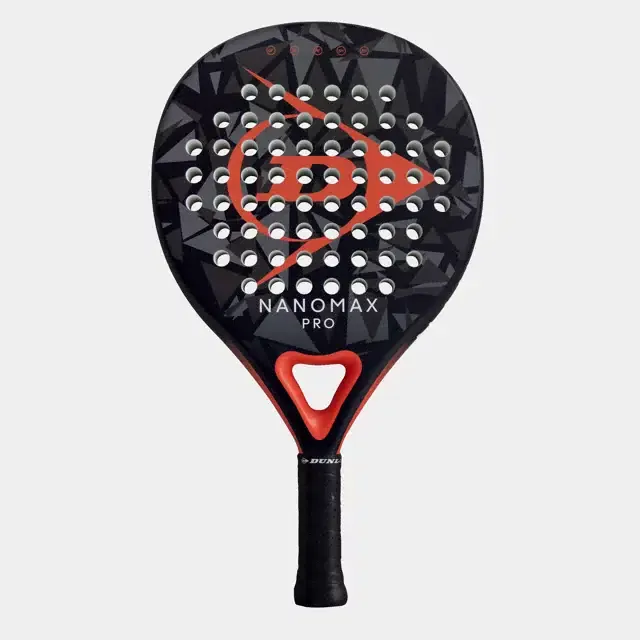
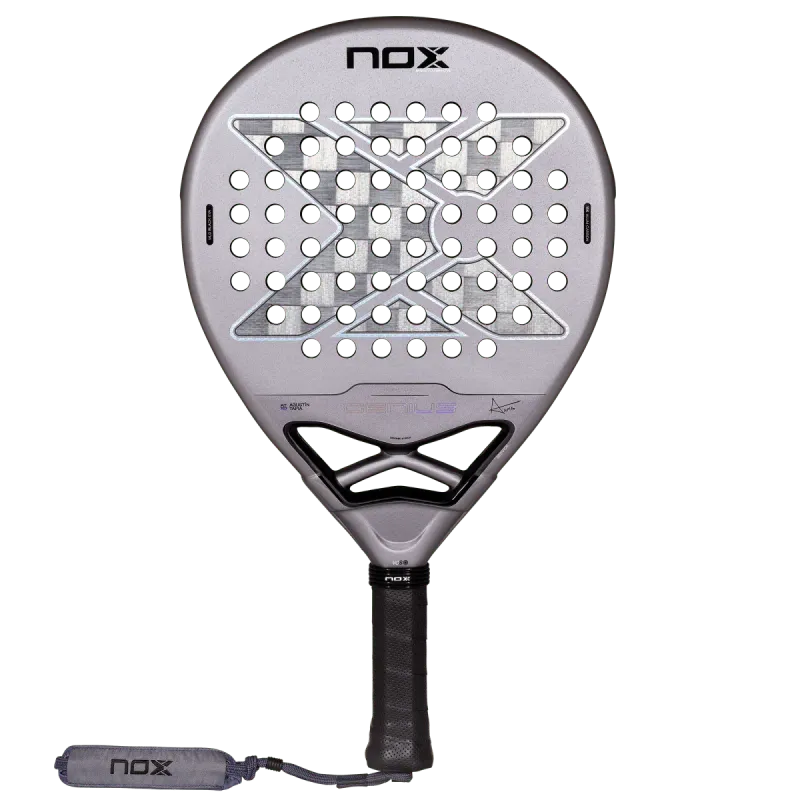
The Dunlop Nanomax Pro is designed for intermediate allrounders seeking a balanced performance on the court, while the NOX Genius 18K Alum Agustín Tapia 2027 targets pro-level players looking for an allrounder or game-builder profile. In our assessment, both rackets offer a medium core hardness, a medium sweet spot, and an equal 3/5 power-versus-control balance. Choosing between them comes down to your skill level, material preferences, and desired weight configuration.
| Feature | Dunlop Nanomax Pro | NOX Genius 18K Alum Agustín Tapia 2027 |
|---|---|---|
| Target level (Manufacturer) | Intermediate | Pro |
| Season (Manufacturer) | Not stated | 2027 |
| Weight (Manufacturer) | 365 g | 360–375 g |
| Thickness (Manufacturer) | Not stated | 38 mm |
| Frame material (Manufacturer) | Not stated | Carbon |
| Face material (Manufacturer) | Not stated | Carbon Fiber 18K Alum |
| Core material (Manufacturer) | Pro EVA | MLD Black Eva |
| Racket shape (our assessment) | Hybrid | Teardrop (Manufacturer stated) |
| Core hardness (our assessment) | Medium | Medium |
| Power vs control rating (our assessment) | 3 / 5 | 3 / 5 |
| Sweet spot size (our assessment) | Medium | Medium |
| Recommended player types (our assessment) | Allrounder | Allrounder, Builder |
Which one has more power?
In our assessment, neither racket holds a distinct power advantage over the other. We rate both the Dunlop Nanomax Pro and the NOX Genius 18K Alum Agustín Tapia 2027 at a 3 out of 5 on our power versus control scale, where 1 indicates pure control and 5 represents pure power.
Both models are engineered for balanced play rather than extreme overhead power. When hitting offensive shots at the net such as a bandeja, vibora, or kick smash, both rackets deliver moderate output. The Dunlop relies on its manufacturer-specified Pro EVA core, whereas the NOX pairs an MLD Black Eva core with a Carbon Fiber 18K Alum face and Carbon frame. Because neither racket is heavily weighted toward maximum power, players must generate their own pace on attacking shots.
Which is easier to play?
In our assessment, both rackets share a medium core hardness and a medium sweet spot, providing predictable handling when defending off the back glass or controlling rallies at the net. However, their ease of play differs significantly depending on player experience.
The Dunlop Nanomax Pro is explicitly aimed at intermediate players by the manufacturer. With a set weight of 365 g, it offers straightforward handling for developing players who need a balanced setup without overly rigid materials. The exact frame and face construction are not stated by the manufacturer.
In contrast, the NOX Genius 18K Alum Agustín Tapia 2027 is specified for pro-level players. It comes in a weight range of 360–375 g and features a standard 38 mm profile with carbon construction. While its medium core hardness and medium sweet spot maintain accessibility in our assessment, its pro specification demands solid technique. Neither manufacturer provides specific claims regarding arm comfort or shock absorption, so these aspects are not stated.
How do their player profiles and trade-offs compare?
The primary trade-off between these two models comes down to target skill level and material transparency.
The Dunlop Nanomax Pro provides a well-rounded foundation for intermediate allrounders. In our assessment, its hybrid shape and balanced rating suit players who switch seamlessly between attack and defense on either side of the court. Its main limitation is that technical details regarding the frame, face material, and thickness are not stated by the manufacturer.
The NOX Genius 18K Alum Agustín Tapia 2027 offers complete material specifications from the manufacturer, including a teardrop shape, carbon frame, Carbon Fiber 18K Alum face, and 2027 season designation. In our assessment, it serves both allrounders and game builders who construct points systematically from the back line or transition to the net. However, its pro-level targeting means it is optimized for highly advanced players.
Who should buy which?
Dunlop Nanomax Pro:
- Intermediate players who want a balanced, reliable racket.
- Allrounders playing on either side of the court who split time equally between net play and back-court defense.
- Players who want a fixed 365 g weight setup with a Pro EVA core.
NOX Genius 18K Alum Agustín Tapia 2027:
- Advanced and pro-level players looking for premium carbon construction (Carbon Fiber 18K Alum).
- Tacticians and builders who like to control point tempo as well as versatile allrounders.
- Players who prefer a teardrop shape with a 360–375 g weight range and a standard 38 mm thickness.
Frequently asked questions
What is the power versus control rating for these rackets?
In our assessment, both the Dunlop Nanomax Pro and the NOX Genius 18K Alum Agustín Tapia 2027 receive a 3 out of 5 on our power versus control scale, meaning they balance power and control equally.
What skill levels do these rackets target?
The manufacturer states that the Dunlop Nanomax Pro is designed for intermediate players, while the NOX Genius 18K Alum Agustín Tapia 2027 is built for pro-level players.
Are the frame and face materials known for both models?
The manufacturer specifies that the NOX Genius 18K Alum Agustín Tapia 2027 features a Carbon frame and a Carbon Fiber 18K Alum face. The frame and face materials for the Dunlop Nanomax Pro are not stated by the manufacturer.