

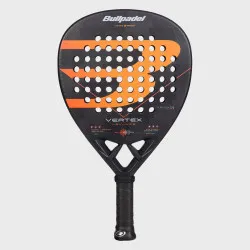
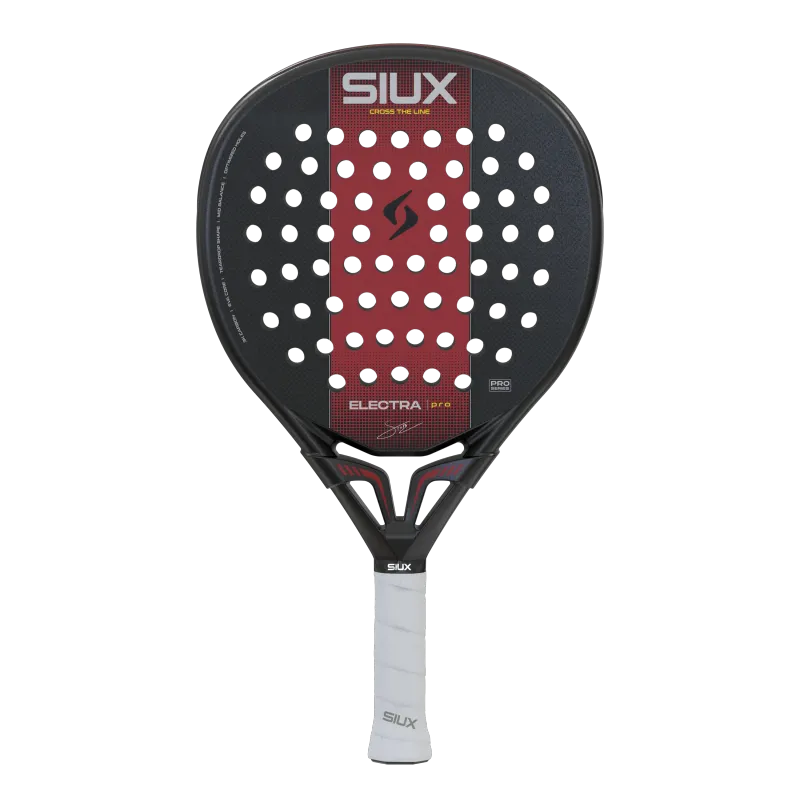
The Bullpadel Vertex Advance is tailored for intermediate attacking players who want a diamond shape paired with a low balance and a medium core. The Siux Electra Pro is built for advanced all-round players seeking a teardrop shape with an even balance and a stiff, hard core. Your choice depends on whether you prioritize maneuverability and controlled overheads or maximum ball output for aggressive all-court play.
| Feature | Bullpadel Vertex Advance | Siux Electra Pro |
|---|---|---|
| Target Level (manufacturer) | Intermediate | Advanced |
| Racket Shape (manufacturer) | Diamond | Teardrop |
| Balance (manufacturer) | Low | Even |
| Weight (manufacturer) | 365–375 g | 355–375 g |
| Thickness (manufacturer) | 38 mm | Not stated |
| Frame / Face Materials (manufacturer) | Carbon and fiberglass hybrid face | Carbon 12K frame |
| Core Type (manufacturer) | Not stated | Hard |
| Core Hardness (our assessment) | Medium | Hard |
| Power vs Control (our assessment) | 3 / 5 | 4 / 5 |
| Sweet Spot Size (our assessment) | Small | Medium |
| Player Type (our assessment) | Attacker | Allrounder |
Which racket offers more power at the net?
When attacking at the net, power relies heavily on racket balance, core hardness, and overall shape. In our assessment, we rate the Siux Electra Pro higher in power, giving it a 4 out of 5 on our power versus control scale. Its hard core, as stated by the manufacturer, combined with an even balance and a Carbon 12K frame, provides a stiff touch that helps generate pace on smashes and aggressive viboras.
By contrast, in our assessment, we rate the Bullpadel Vertex Advance at a balanced 3 out of 5 for power versus control. Although the manufacturer specifies a diamond shape for this model, they also list a low balance point. In our assessment, its core hardness is medium. This combination makes it easier to control aggressive shots without sending the ball long, but it offers less explosive power on overheads compared to the Siux. Left-side attacking players who rely on sheer power to finish points will prefer the stiffness of the Electra Pro, while intermediate players who want controlled offensive play will find the Vertex Advance more manageable.
Which one is easier to manage on defense?
Defending behind the glass and handling fast chiquitas requires good control, maneuverability, and arm comfort. The Bullpadel Vertex Advance features a low balance point stated by the manufacturer, which helps keep the racket nimble when defending low balls off the back wall. Its face utilizes a blend of carbon fiber and fiberglass developed by Bullpadel. Combined with what we rate as a medium core hardness, this gives the ball extra outlet on defensive block shots. However, in our assessment, the sweet spot of the Vertex Advance is small, meaning precise contact is required to avoid off-center hits.
The Siux Electra Pro features a teardrop shape and an even balance, with a weight range starting slightly lighter at 355–375 g. In our assessment, it provides a medium sweet spot, making it slightly more forgiving on off-center hits when defending off the glass. However, its manufacturer-stated hard core and our assessment of a hard feel mean that defensive lobs requires solid wrist control and precise technique. Players looking for arm comfort and higher forgiveness during intense rallies will benefit from the medium feel of the Vertex Advance, whereas technically sound advanced players can maximize the versatility of the Electra Pro.
How do their materials and physical specs compare?
The build profiles of these two rackets cater to different player levels and court demands. The Bullpadel Vertex Advance comes in a traditional 38 mm thickness, weighing 365–375 g. The manufacturer states that the face is made from a hybrid carbon and fiberglass mixture. The manufacturer does not state the exact core material or frame composition for the Vertex Advance, though in our assessment, its core hardness falls into the medium category.
For the Siux Electra Pro, the manufacturer highlights a Carbon 12K frame and a hard core, with a weight range of 355–375 g and an even balance. The manufacturer does not state the racket thickness. In our assessment, the core hardness is hard. This creates a much stiffer overall surface than the hybrid construction of the Vertex Advance, translating into a firmer impact feel when striking bandejas or volleys.
Who should buy which?
Bullpadel Vertex Advance is best for:
- Intermediate players wanting an attacking diamond layout with better maneuverability.
- Drive or reverse side players who prefer a low balance point and a carbon-fiberglass hybrid surface.
- Attackers who want a medium core hardness (in our assessment) to balance touch with control.
Siux Electra Pro is best for:
- Advanced players who play an all-round game across all areas of the court.
- Aggressive players seeking a higher power output (rated 4 out of 5 in our assessment).
- Players who prefer a teardrop shape with a hard core and a Carbon 12K frame.
Frequently asked questions
Which player levels are these rackets designed for?
According to the respective manufacturers, the Bullpadel Vertex Advance is designed for intermediate players, while the Siux Electra Pro is built for advanced players.
What are the power vs control ratings for each racket?
In our assessment, the Bullpadel Vertex Advance receives a 3 out of 5 on our power versus control scale, while the Siux Electra Pro receives a higher power rating of 4 out of 5.
How do the sweet spots compare between the two models?
In our assessment, the Bullpadel Vertex Advance has a small sweet spot, whereas the Siux Electra Pro features a medium sweet spot.