

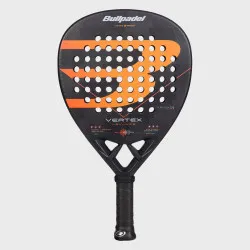
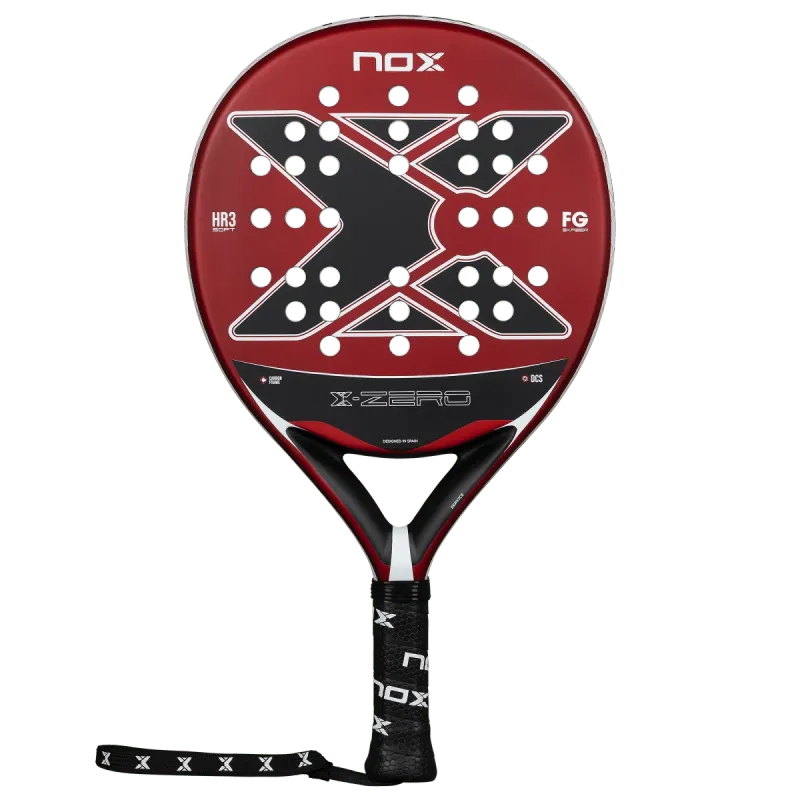
The Bullpadel Vertex Advance is best suited for intermediate attacking players who want a diamond-shaped racket with a low balance and a solid blend of materials for aggressive play. In contrast, the NOX X-Zero is ideal for beginners, game builders, and counter-players who require a light, round frame with maximum forgiveness. Choosing between them comes down to whether you prioritize controlled offensive output or easy handling and defensive consistency.
| Feature | Bullpadel Vertex Advance | NOX X-Zero |
|---|---|---|
| Player Level (manufacturer) | Intermediate | Beginner |
| Shape (manufacturer) | Diamond | Round |
| Weight (manufacturer) | 365–375 g | 350–360 g |
| Balance (manufacturer) | Low | Not stated |
| Thickness (manufacturer) | 38 mm | Not stated |
| Face Material (manufacturer) | Carbon fiber and fiberglass blend | Fiber Glass 3K |
| Core Hardness (our assessment) | Medium | Not stated |
| Power vs Control (our assessment) | 3 (Scale 1-5, where 1=control, 5=power) | Not stated |
| Sweet Spot (our assessment) | Small | Large |
| Recommended Player Types (our assessment) | Attacker | Builder, Counter |
Which racket offers more power and performance at the net?
The Bullpadel Vertex Advance is designed with an offensive mindset in mind. Built with a diamond shape and a total weight of 365–375 g, it provides substantial mass when hitting through the ball. In our assessment, we rate its power-vs-control balance at 3 on a 1-to-5 scale (where 1 represents pure control and 5 represents pure power). Combined with a medium core hardness in our assessment, this setup allows attacking players to generate solid force on smashes, sharp volleys, and aggressive bandeja shots. The manufacturer states that the face features a specialized blend of carbon fiber and fiberglass, giving the racket enough structural support to transmit energy efficiently during overhead attacks.
Conversely, the NOX X-Zero is not built around raw power. With a round shape and a lower weight range of 350–360 g, it is engineered for precision and control rather than overhead speed. Its balance, thickness, core hardness, and power-vs-control rating are not stated. However, its fiberglass construction (Fiber Glass 3K) and round geometry make it suited for game builders and counter-attackers who rely on placement, defensive lobs, and reset shots rather than overpowering opponents at the net.
Which is easier to play with and control?
Ease of play relies heavily on shape, weight distribution, and forgiving hit areas. The NOX X-Zero stands out as the far more accessible option for less experienced players. Designed for beginners, it pairs a lightweight 350–360 g frame with a round geometry. In our assessment, it features a large sweet spot. This makes defending off the glass or handling fast-paced balls from the back court significantly easier, as off-center contact is less likely to result in unforced errors.
In comparison, the Bullpadel Vertex Advance presents a steeper learning curve. Even though the manufacturer specifies a low balance, the combination of a diamond shape, a 38 mm profile, and a weight of 365–375 g demands better technical execution. Furthermore, in our assessment, the sweet spot of the Vertex Advance is small. Players who do not hit cleanly near the center of the face may struggle with control, particularly when defending tricky wall bounces or reacting under pressure. Therefore, arm comfort and forgiveness clearly favor the NOX model for entry-level players.
What are the main material and structural differences?
When examining the specifications provided by the manufacturers and our assessment, key differences emerge in frame geometry and construction:
- Shape & Geometry: The Vertex Advance features a traditional diamond shape geared toward aggressive trajectories, whereas the X-Zero uses a round shape aimed at central balance and consistent ball contact.
- Face Materials: Bullpadel utilizes a proprietary blend combining carbon fiber and fiberglass on the hitting surface. NOX uses a Fiber Glass 3K face.
- Weight & Profile: The Vertex Advance sits in a heavier range of 365–375 g with a standard 38 mm thickness and low balance. The X-Zero is lighter at 350–360 g; its thickness and balance are not stated by the brand.
- Core Characteristics (our assessment): We assess the Vertex Advance as having a medium core hardness, while the core hardness for the NOX X-Zero is not stated.
Who should buy which?
Bullpadel Vertex Advance is best for:
- Intermediate players who want a step up in structure to support an aggressive style.
- Attacking players who frequently look to finish points at the net with smashes, viboras, and heavy volleys.
- Players comfortable with a small sweet spot who can consistently hit the center of the racket face.
- Left-side (court) players who prefer a diamond-shaped racket with a 365–375 g weight profile.
NOX X-Zero is best for:
- Beginner padel players seeking a forgiving, high-control racket to develop fundamental technique.
- Builders and counter-players who rely on precision, high lobs, and returning fast shots off the back glass.
- Players looking for a lighter frame in the 350–360 g range to ensure easy maneuverability and arm comfort.
- Right-side (court) players who focus on consistency, placement, and constructing the point patiently.
Frequently asked questions
What skill level is required for each racket?
According to the respective manufacturers, the NOX X-Zero is specifically designed for beginner players, whereas the Bullpadel Vertex Advance is aimed at intermediate players who possess better technical consistency.
How do the sweet spots compare between these two models?
In our assessment, the NOX X-Zero has a large sweet spot, making it forgiving on off-center hits. The Bullpadel Vertex Advance, in our assessment, has a small sweet spot, requiring more precise contact from the player.
What are the exact weight ranges stated by the manufacturers?
The Bullpadel Vertex Advance has an official weight range of 365–375 g, while the NOX X-Zero comes in a lighter range of 350–360 g.