

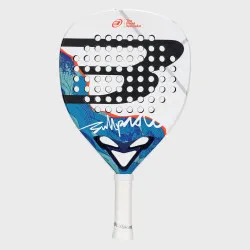
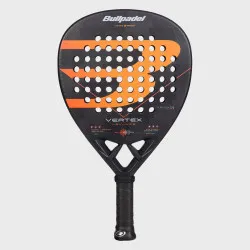
The Bullpadel Ionic Power 2026 is engineered for advanced attacking players who rely on a high balance for explosive overhead shots and maximum leverage at the net. In contrast, the Bullpadel Vertex Advance suits intermediate attacking players seeking the offensive geometry of a diamond frame paired with a low balance for easier handling and defensive maneuverability. In our assessment, while both models share a medium core hardness and a small sweet spot, player experience level and balance preference determine which option fits best.
| Specification / Feature | Bullpadel Ionic Power 2026 | Bullpadel Vertex Advance |
|---|---|---|
| Target Player Level (manufacturer) | Advanced | Intermediate |
| Season | 2026 | Not stated |
| Frame Shape | Diamond | Diamond |
| Balance | High | Low |
| Weight | 365–375 g | 365–375 g |
| Thickness | 38 mm | 38 mm |
| Face Material | Mix of carbon fiber and fiberglass | Mix of carbon fiber and fiberglass |
| Core Hardness (our assessment) | Medium | Medium |
| Power vs Control (our assessment) | 4 / 5 | 3 / 5 |
| Sweet Spot (our assessment) | Small | Small |
| Player Type (our assessment) | Attacker | Attacker |
Which racket offers more power on the court?
When comparing offensive capabilities, the Bullpadel Ionic Power 2026 takes the advantage for pure attacking power. The manufacturer specifies a high balance for the Ionic Power 2026, placing additional weight near the top of the frame. In our assessment, we rate its power vs control at 4 out of 5 on a scale where 1 represents pure control and 5 represents pure power. This high-mass distribution generates enhanced leverage when executing overhead smashes, aggressive viboras, and deep bandejas from the back court.
The Bullpadel Vertex Advance also features a diamond shape tailored for attacking styles, but the manufacturer specifies a low balance. In our assessment, we rate its power vs control at 3 out of 5. Because the mass is located closer to the grip, it provides less head leverage on heavy overhead strikes than the Ionic Power 2026. However, it still offers enough pop for attacking play while delivering a more balanced, controlled feel during full-swing offensive exchanges.
Which racket is easier to handle and control?
Handling and defensive performance are heavily influenced by weight distribution. Both models share identical weight ranges of 365–375 g and standard 38 mm profile thickness, yet their balance points create noticeably different experiences on court. The low balance of the Bullpadel Vertex Advance makes it much easier to maneuver during fast exchanges at the net or when defending low balls off the back glass. Players needing extra time to react to fast returns will find the low balance forgiving on the wrist and forearm during rapid transitions.
Conversely, the Bullpadel Ionic Power 2026 demands greater physical effort and refined technique due to its top-heavy design. Quick defensive adjustments when defending off the glass require strong wrist stability and precise timing. Furthermore, in our assessment, both rackets feature a small sweet spot alongside a medium core hardness. Because neither frame offers an enlarged hitting area, off-center contact requires accurate technique on both rackets. However, the Vertex Advance remains easier to play overall because its low balance reduces fatigue and simplifies ball placement under pressure.
How do physical materials and design impact comfort?
Both models feature a face developed by Bullpadel that mixes carbon fiber with fiberglass. This blended construction combines the structural stability of carbon fiber with the elasticity of fiberglass, facilitating smooth ball output. In our assessment, both rackets feature a medium core hardness. This combination provides moderate arm comfort, absorbing excess impact without feeling spongy.
The manufacturer season for the Ionic Power is 2026, while the season for the Vertex Advance is not stated in the official specifications. Neither racket includes specialized dampening ratings or tested arm-comfort claims. However, the lower balance point of the Vertex Advance inherently places less leverage stress on the elbow and shoulder during long matches compared to the head-heavy setup of the Ionic Power 2026. Players seeking an offensive diamond shape who are concerned about arm fatigue will appreciate the lower balance profile.
Who should buy which?
Bullpadel Ionic Power 2026 is ideal for:
- Advanced offensive players who want maximum overhead power and play predominantly on the left or right side.
- Attackers who prefer a high-balance diamond frame to leverage heavy smashes and deep bandejas.
- Players with solid technical mechanics who can handle a top-heavy balance and a small sweet spot.
Bullpadel Vertex Advance is ideal for:
- Intermediate attacking players looking for an offensive diamond shape that remains easy to handle.
- Players who favor a low balance for quick reaction speed in net volleys and easier defense off the glass.
- Attackers seeking a balanced 3/5 power-to-control output (in our assessment) without committing to a head-heavy frame.
Frequently asked questions
What is the main difference between the Bullpadel Ionic Power 2026 and Vertex Advance?
The primary differences are balance and target player level. The Ionic Power 2026 features a high balance and is aimed at advanced players, whereas the Vertex Advance features a low balance and is designated for intermediate players. In our assessment, this gives the Ionic Power 2026 a higher power rating (4/5) compared to the Vertex Advance (3/5).
What player level are these rackets aimed at according to the manufacturer?
According to the manufacturer, the Bullpadel Ionic Power 2026 is designed for advanced-level players, while the Bullpadel Vertex Advance is designed for intermediate-level players.
What face material is used on both rackets?
Both rackets feature a face developed by Bullpadel that mixes carbon fiber with fiberglass, combining durability with a flexible feel upon contact.