

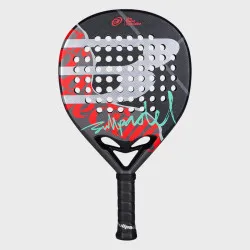
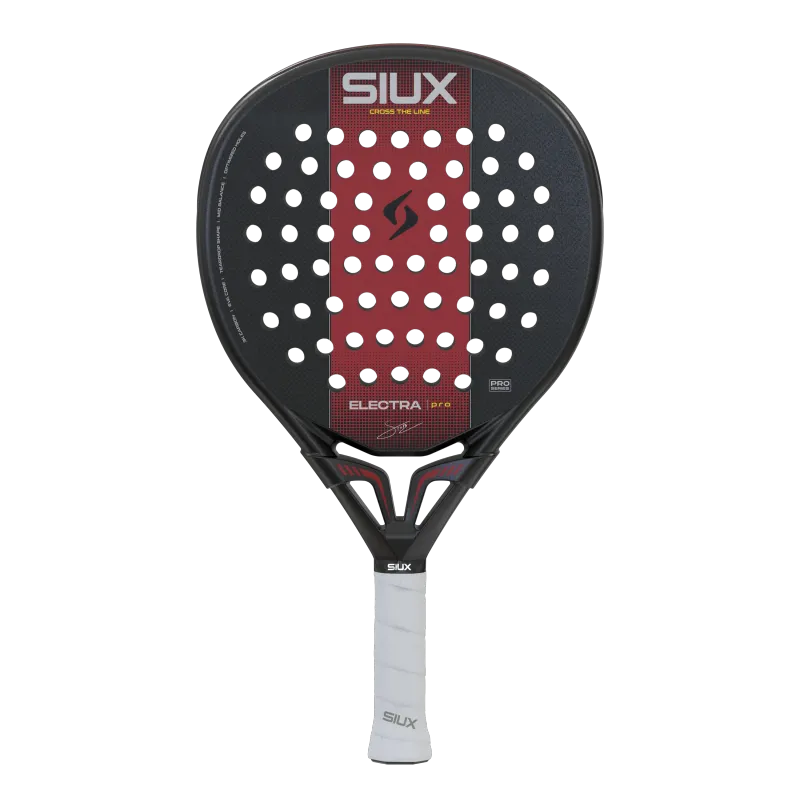
The Bullpadel Ionic Control 26 is best suited for defensive builders and counter-attackers who demand maximum control, maneuverability, and forgiveness from the back of the court. Conversely, the Siux Electra Pro targets advanced all-round players who require a stiffer touch and significantly more power to dominate points at the net. Players prioritizing precision and high forgiveness should choose the Bullpadel, while those seeking explosive force on smashes and viboras will benefit more from the Siux.
| Feature | Bullpadel Ionic Control 26 | Siux Electra Pro |
|---|---|---|
| Manufacturer Shape | Round | Teardrop |
| Manufacturer Balance | Low | Even |
| Weight | 365–375 g | 355–375 g |
| Frame Material | Carbon + Fiberglas | Carbon 12K |
| Core | Dual | Hard |
| Targeted Player Level | Advanced | Advanced |
| Core Hardness (our assessment) | Medium | Hard |
| Power vs Control (our assessment) | 1 (Pure Control) | 4 (Power-focused) |
| Sweet Spot Size (our assessment) | Large | Medium |
| Ideal Player Type (our assessment) | Builder, Counter | Allrounder |
Which racket offers more power at the net?
When transition play moves to the net, the Siux Electra Pro delivers a clear advantage in overall power. According to manufacturer specifications, the Electra Pro features a teardrop shape, an even balance, and a hard core wrapped in a Carbon 12K frame. On our 1 to 5 scale (where 1 represents pure control and 5 represents pure power), we rate the Siux Electra Pro at a 4. This combination of an even balance and rigid construction allows aggressive players to generate high ball speed on smashes, aggressive bandejas, and fast volleys.
The Bullpadel Ionic Control 26 takes a focused control approach. With its round shape, low balance, and dual core design, it is engineered for placement rather than pure velocity. In our assessment, we rate the Ionic Control 26 at a 1 on our power-versus-control scale. While it allows for controlled block volleys and tight placement, it requires more physical output from the player to generate high pace on finishing overheads.
Which one provides better control and maneuverability?
Control and handling are where the Bullpadel Ionic Control 26 excels. Built with a round shape and low balance, it feels agile and responsive during rapid exchanges. In our assessment, we rate its core hardness as medium and note that it possesses a large sweet spot. These features make it exceptionally reliable when defending off the glass, executing precise resets, or lobbing out of deep defensive positions under pressure.
The Siux Electra Pro offers firmer contact feedback due to its hard core and Carbon 12K frame construction. In our assessment, we rate its core hardness as hard and its sweet spot size as medium. While this firm touch gives advanced players crisp accuracy when striking with clean technique, the even balance and teardrop geometry make it slightly less forgiving during quick, reactive defensive recoveries than its round competitor.
How do the construction materials compare?
The structural choices made by each brand dictate how these rackets feel upon ball contact. Bullpadel combines Carbon and Fiberglas in the frame of the Ionic Control 26, paired with a dual core. In our assessment, this combination yields a medium core hardness that provides comfortable feel and moderate output.
Siux constructs the Electra Pro with a stiffer Carbon 12K frame paired with a hard core. Based on these specifications, we assess the core hardness as hard. Weight ranges are broadly similar: the Bullpadel weighs between 365 and 375 grams, whereas the Siux spans 355 to 375 grams, giving the Siux a slightly wider potential weight range depending on the individual unit.
Which is easier to play with during long rallies?
In extended rallies, playability comes down to sweet spot forgiveness and balance. The low balance and round shape of the Bullpadel Ionic Control 26 make fast wrist movement and quick adjustments manageable throughout long matches. In our assessment, its large sweet spot provides reliable margin for error, helping to minimize unforced errors when handling awkward glass rebounds or tight defensive chiquitas.
The Siux Electra Pro demands cleaner technique to maximize performance on every strike. In our assessment, its medium sweet spot requires consistent contact near the center of the racket face. While its even balance maintains reasonable maneuverability for an offensive-capable racket, it demands active footwork and precise timing in fast-paced transition play.
Who should buy which?
Bullpadel Ionic Control 26 is best for:
- Advanced right-side builders and defensive counter-attackers who prioritize consistency and control.
- Players who want a low balance and round shape for maximum agility in defensive scenarios.
- Anyone seeking a large sweet spot (in our assessment) and a medium core hardness for comfortable defense off the glass.
Siux Electra Pro is best for:
- Advanced all-round players who want balanced playability with strong offensive capabilities.
- Attackers looking for elevated power (rated 4 in our assessment) on smashes, viboras, and aggressive net volleys.
- Players who prefer a firm impact feel provided by a Carbon 12K frame and a hard core.
Frequently asked questions
What is the power versus control rating for these rackets?
In our assessment on a scale from 1 (pure control) to 5 (pure power), we rate the Bullpadel Ionic Control 26 at 1 for pure control, while we rate the Siux Electra Pro at 4 for a strong power bias.
Which player level are these rackets designed for?
Both the Bullpadel Ionic Control 26 and the Siux Electra Pro are specified for advanced players by their respective manufacturers.
How do the sweet spots compare between the two rackets?
In our assessment, the Bullpadel Ionic Control 26 features a large sweet spot, whereas we assess the Siux Electra Pro as having a medium sweet spot.