

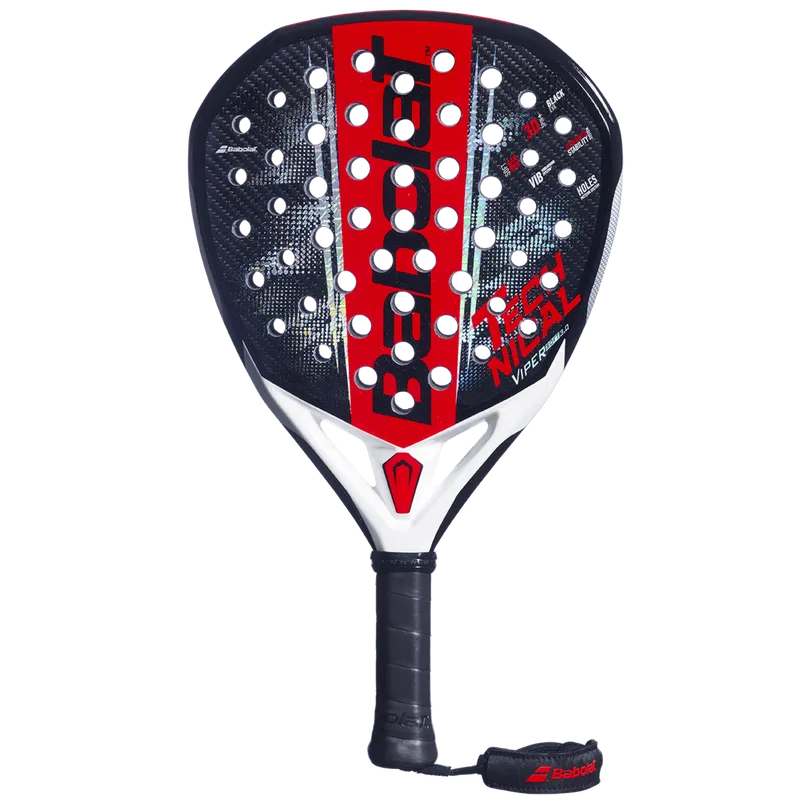
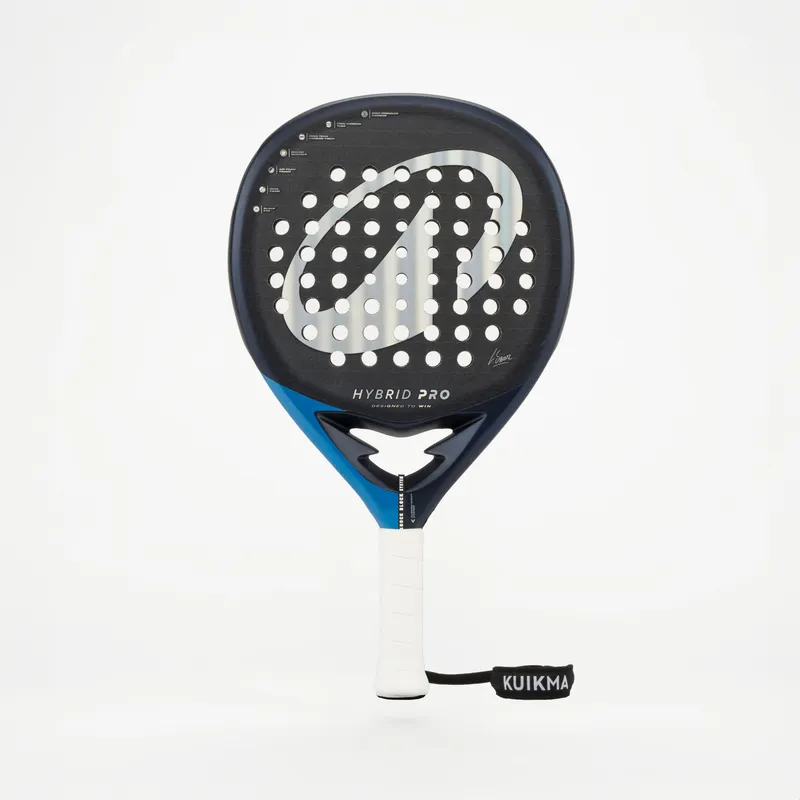
The Babolat Technical Viper is an unyielding power racket designed for pro-level attacking players who demand maximum pace on their offensive shots. In contrast, the Kuikma Hybrid Pro offers a balanced setup tailored to advanced allrounders and attackers seeking versatility across all areas of the court. Choosing between them comes down to whether you prefer a heavier, diamond-shaped power weapon or a versatile hybrid model with a forgiving sweet spot.
| Feature | Babolat Technical Viper | Kuikma Hybrid Pro |
|---|---|---|
| Manufacturer Shape | Diamond | Hybrid |
| Manufacturer Weight | 370 g | 365 g |
| Manufacturer Balance | High | Not stated |
| Manufacturer Frame | Carbon 16K/3K | Not stated |
| Manufacturer Core | Hard | Not stated |
| Manufacturer Thickness | Not stated | 38 mm |
| Manufacturer Player Level | Pro | Not stated |
| Core Hardness (our assessment) | Hard | Medium |
| Power vs Control (our assessment) | 5 (Pure power) | 3 (Balanced) |
| Sweet Spot (our assessment) | Small | Medium |
| Recommended Level (our assessment) | Not stated | Advanced |
| Player Types (our assessment) | Attacker | Allrounder, Attacker |
Which one has more power?
When evaluating offensive capability, the Babolat Technical Viper stands out as a dedicated power option. Its manufacturer specifications include a diamond shape, a high balance, a weight of 370 g, and a Carbon 16K/3K frame paired with a hard core. In our assessment, we rate its power versus control at 5 out of 5, placing it squarely in the pure power category. This combination helps generate high ball output on aggressive aerial shots, such as the smash, flat overheads, or sharp viboras near the net. It is particularly effective for left-side attacking players who prioritize finishing points with high ball speed.
The Kuikma Hybrid Pro takes a more moderate approach to offensive play. The manufacturer specifies a hybrid shape and a weight of 365 g, while frame material and core type are not stated by the brand. In our assessment, we rate its power versus control at 3 out of 5, representing a neutral balance between power and control. While it provides sufficient punch for attacking volleys, it does not match the raw impact of the Technical Viper's head-heavy, hard-core setup.
Which is easier to play and handle?
Handling and playability vary significantly between these two models due to their physical specifications and internal characteristics.
In our assessment, the Babolat Technical Viper features a small sweet spot and a hard core. Combined with a manufacturer-stated high balance and a 370 g weight, it presents a demanding profile. Defending deep off the glass or handling rapid wall rebounds requires consistent center contact and solid technique. Players who miss the small sweet spot may experience lower comfort, making arm conditioning an important consideration for long matches.
Conversely, the Kuikma Hybrid Pro is more forgiving in defensive scenarios. In our assessment, it features a medium sweet spot and a medium core hardness. Its manufacturer weight of 365 g is 5 grams lighter than the Viper, and it features a standard 38 mm profile thickness. These factors make it easier to handle when executing defensive lobs, transition blocks, or precise touches off the glass. For players looking for a manageable response without sacrificing total structure, the Hybrid Pro is the easier racket to maneuver.
How do they perform across court positions?
At the net, the Babolat Technical Viper thrives when attacking high balls. Its high balance and hard carbon construction allow offensive players to put maximum speed on aggressive bandejas and smashes. However, during fast net exchanges where quick reaction time is required, its 370 g weight and high balance require strong wrist stability.
The Kuikma Hybrid Pro excels in transition play and varied rally situations. At the net, it offers control for placed volleys and drop shots while maintaining enough weight (365 g) for firm block volleys. Deep behind the baseline, its medium sweet spot and medium core hardness assist in pushing defensive balls deep into the opponent's court, whereas the Technical Viper demands precise power generation from the player to avoid short returns off the glass.
Who should buy which?
Babolat Technical Viper:
- Pro-level players seeking maximum offensive capability (rated 5/5 power in our assessment).
- Aggressive attackers who predominantly play on the left side of the court.
- Players comfortable managing a high balance, a 370 g total weight, a hard core, and a small sweet spot.
Kuikma Hybrid Pro:
- Advanced players who want an equal mix of power and control (rated 3/5 power vs control in our assessment).
- Allrounders and attackers who prefer a medium sweet spot and medium core hardness.
- Players seeking a hybrid shape with a 365 g weight and a 38 mm frame profile.
Frequently asked questions
What is the core hardness of each racket?
The manufacturer lists a hard core for the Babolat Technical Viper, while the core material for the Kuikma Hybrid Pro is not stated by its manufacturer. In our assessment, we rate the Babolat Technical Viper as having a hard core and the Kuikma Hybrid Pro as having a medium core hardness.
What player levels are these rackets designed for?
The manufacturer designates the Babolat Technical Viper for pro-level players. The manufacturer does not state the target player level for the Kuikma Hybrid Pro, but in our assessment, we rate it as suitable for advanced players.
What are the main weight and shape differences between the two?
The Babolat Technical Viper features a diamond shape, high balance, and a manufacturer weight of 370 g. The Kuikma Hybrid Pro features a hybrid shape, a manufacturer weight of 365 g, and a thickness of 38 mm, though its balance is not stated by the manufacturer.