

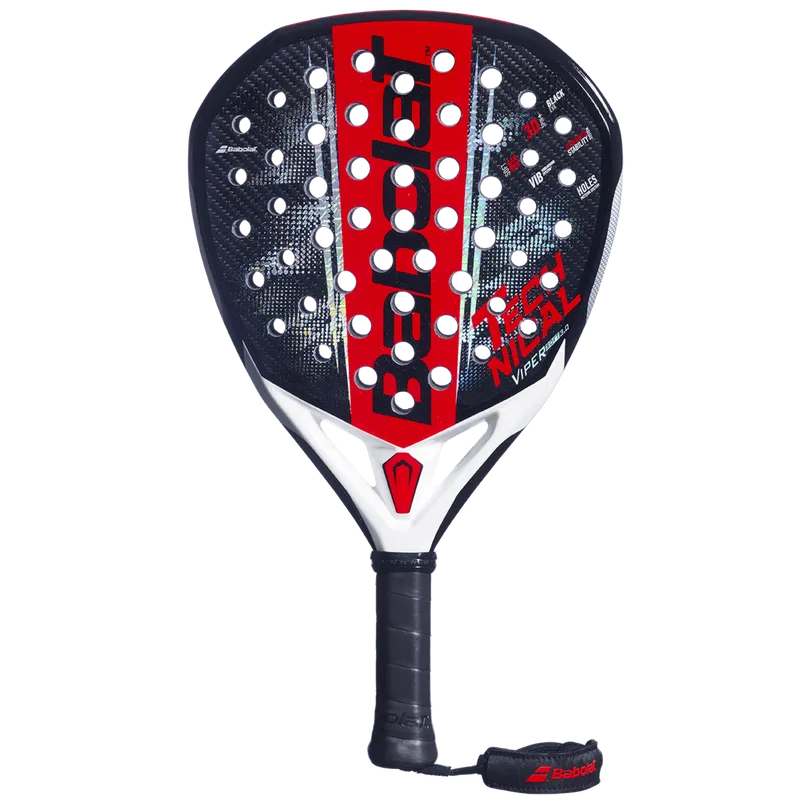
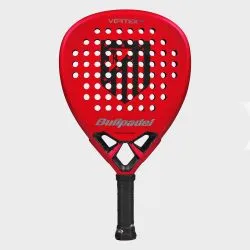
The Babolat Technical Viper is built for advanced attackers who demand a rigid feel and maximum finishing power on every overhead shot. The Bullpadel Vertex 02 Atletico Madrid is also tailored for aggressive pro-level play, though in our assessment, its medium core hardness provides a touch more comfort than the firm Babolat. Both diamond-shaped models feature high balance and small sweet spots, requiring sound technical execution on court.
| Feature | Babolat Technical Viper | Bullpadel Vertex 02 Atletico Madrid |
|---|---|---|
| Target Player Level (manufacturer) | Pro | Pro |
| Racket Shape (manufacturer) | Diamond | Diamond |
| Balance (manufacturer) | High | High |
| Weight (manufacturer) | 370 g | 365–375 g |
| Thickness (manufacturer) | Not stated | 38 mm |
| Frame Material (manufacturer) | Carbon 16K/3K | Not stated |
| Core Material (manufacturer) | Hard | Not stated |
| Core Hardness (our assessment) | Hard | Medium |
| Power vs Control (our assessment) | 5 / 5 (Pure power) | 5 / 5 (Pure power) |
| Sweet Spot Size (our assessment) | Small | Small |
| Player Type (our assessment) | Attacker | Attacker |
Which racket delivers more power on the court?
In our assessment, both rackets achieve a maximum 5 out of 5 on the power-versus-control scale, making them dedicated offensive tools for aggressive play. However, they generate that output through different technical setups. The Babolat Technical Viper combines high balance and a fixed 370 g weight with a hard core (as stated by the manufacturer) and Carbon 16K/3K frame construction. In our assessment, this rigid build maximizes kinetic transfer when striking kick smashes or fast viboras, provided the player connects cleanly in the sweet spot.
The Bullpadel Vertex 02 Atletico Madrid relies on high balance, a 38 mm thickness, and a weight range of 365–375 g. While the manufacturer does not specify the exact frame or core materials, we rate its core hardness as medium. This slightly softer core assessment means the Bullpadel offers a bit more trampolining effect on full-swing attacks, whereas the stiffer Babolat depends more heavily on raw player strength to generate maximum ball velocity.
Which model provides better control and maneuverability?
Neither of these rackets is engineered for easy defensive handling. In our assessment, both models feature a small sweet spot and high balance, which naturally shifts weight toward the head of the frame. When defending deep off the glass or executing delicate lobs under pressure, off-center hits will feel unforgiving on both options.
Maneuvering these rackets deep in the court requires strong wrist stability. The Babolat Technical Viper's rigid frame and assessed hard core give precise, direct feedback, but off-center strikes when defending off the glass can feel harsh on the arm. In our assessment, the Bullpadel Vertex 02 Atletico Madrid provides slightly higher arm comfort and easier ball release in slower defensive rallies due to its medium core hardness. However, its head-heavy balance still demands early preparation when transitioning from defense to attack. Note that frame thickness for the Babolat is not stated, whereas the Bullpadel measures the standard 38 mm.
How do they perform in real match situations?
At the net, both rackets excel during offensive volleys and aggressive overheads. On the smash, the Babolat Technical Viper's hard core and head-heavy balance allow players with fast arm speed to drive the ball out of the court with high precision. During fast-paced net exchanges, the extra frame stiffness prevents the racket from absorbing ball energy, allowing block volleys to punch deep.
When hitting viboras or heavy bandejas, the Bullpadel Vertex 02 Atletico Madrid delivers a strong overhead punch while its medium core (in our assessment) gives the player slightly more dwell time to guide spin into the corners. Defending off the glass remains demanding with both models. Left-side offensive players who consistently look to attack overheads will gain the most from either racket, whereas players seeking forgiving defensive control or a large sweet spot should consider lighter or rounder alternatives.
Who should buy which?
Babolat Technical Viper
- Pro-level attackers looking for pure power with an assessed 5 out of 5 power rating.
- Left-side court players who rely heavily on overhead smashes, fast viboras, and aggressive net play.
- Players who prefer a very firm, rigid impact feel derived from a manufacturer-stated hard core and Carbon 16K/3K frame.
Bullpadel Vertex 02 Atletico Madrid
- Advanced and pro-level attackers seeking a high-balance overhead weapon.
- Players who want maximum offensive power (rated 5 in our assessment) but prefer a medium core hardness for slightly better arm comfort.
- Attacking players looking for a standard 38 mm thickness diamond model within a 365–375 g weight range.
Frequently asked questions
What is the main difference between the Babolat Technical Viper and the Bullpadel Vertex 02 Atletico Madrid?
The main difference lies in core hardness and material specs. The Babolat Technical Viper features a manufacturer-stated hard core and Carbon 16K/3K frame (assessed as hard), while the Bullpadel Vertex 02 Atletico Madrid has unstated frame and core materials from the brand, but is assessed by us as having a medium core hardness. The Bullpadel specifies a 38 mm thickness and a 365–375 g weight range, whereas the Babolat weighs 370 g and its thickness is not stated.
Are these rackets suitable for intermediate players?
No. Both brands classify these models for pro-level players. Furthermore, in our assessment, both rackets have small sweet spots, high balance, and pure power ratings (5 out of 5), making them difficult to handle without high-level technique, especially when defending off the glass.
Which court position best suits these rackets?
Both rackets are built for dedicated attackers, making them best suited for left-side players (or aggressive right-side players) whose primary objective is finishing points with powerful smashes, bandejas, and punchy net volleys.