

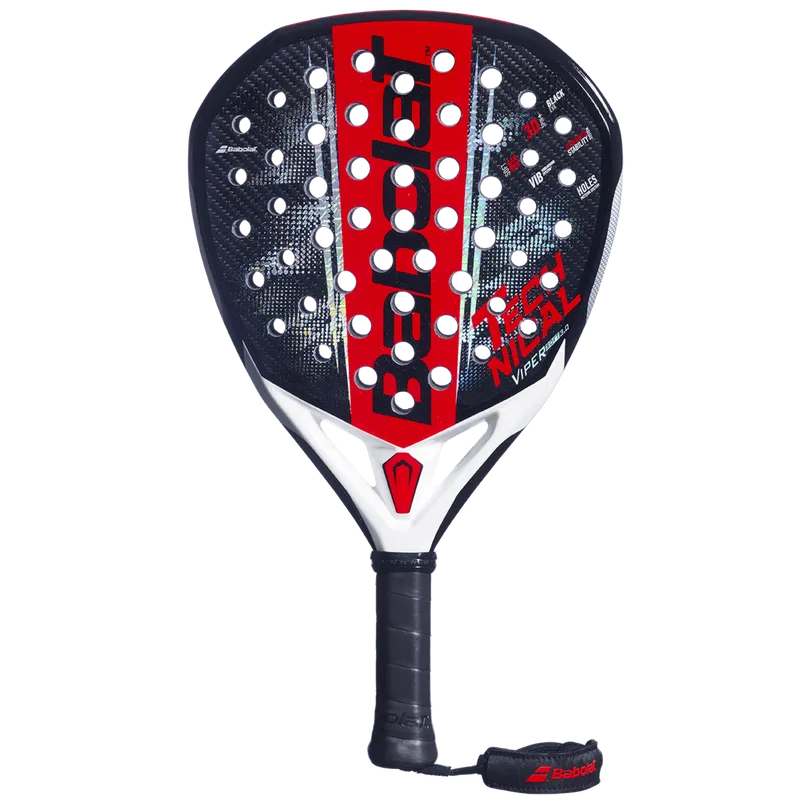
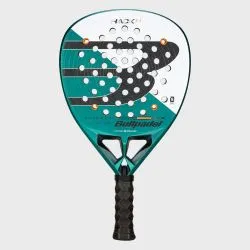
The Babolat Technical Viper is engineered for pure offensive force, making it the ideal choice for aggressive left-side players who rely on maximum power for smashes and overheads. The Bullpadel Hack 04 2025 delivers high balance and diamond-shaped attacking potential with a slightly more moderate core feel, making it well-suited for pro-level offensive players seeking high power without maximum rigidity. Both rackets target advanced attackers, but their distinct core hardness and power ratings set them apart.
| Feature / Specification | Babolat Technical Viper | Bullpadel Hack 04 2025 |
|---|---|---|
| Season | Not stated | 2025 |
| Player Level (manufacturer) | Pro | Pro |
| Shape (manufacturer) | Diamond | Diamond |
| Balance (manufacturer) | High | High (26.4 cm) |
| Weight (manufacturer) | 370 g | 365–375 g |
| Thickness (manufacturer) | Not stated | 38 mm |
| Frame Material (manufacturer) | Carbon 16K/3K | Not stated |
| Core Material (manufacturer) | Hard | Not stated |
| Core Hardness (our assessment) | Hard | Medium |
| Power vs Control (our assessment) | 5 / 5 | 4 / 5 |
| Sweet Spot (our assessment) | Small | Small |
| Player Types (our assessment) | Attacker | Attacker |
Which one has more power?
When evaluating raw power, the Babolat Technical Viper takes the edge in our assessment. We rate the Technical Viper at a maximum 5 out of 5 on our power vs control scale, whereas the Bullpadel Hack 04 2025 is rated at a 4 out of 5. The manufacturer specifies a hard core and a Carbon 16K/3K frame for the Technical Viper, which combines with its high balance and diamond shape to create maximum energy transfer on aggressive overhead shots like smashes, power bandejas, and attacking viboras.
The Bullpadel Hack 04 2025 also provides substantial power thanks to its diamond shape, high balance (measured at 26.4 cm balance by the manufacturer), and 38 mm thickness. However, in our assessment, its core hardness is medium rather than hard. The manufacturer core composition and frame materials for the Hack 04 2025 are not stated. This medium core hardness in our assessment provides plenty of depth on attacking shots, but it produces slightly less absolute rigidity than the Technical Viper, placing it just behind in pure power potential.
Which is easier to play and handle?
Neither of these rackets is designed for ease of play or beginner forgiveness. Both models feature a diamond shape, high balance, and a pro player level specification from their respective manufacturers. Furthermore, in our assessment, both the Babolat Technical Viper and the Bullpadel Hack 04 2025 feature a small sweet spot, meaning off-center hits will result in a drop in performance.
Handling differences stem primarily from core hardness and weight distribution. In our assessment, the Bullpadel Hack 04 2025 features a medium core hardness compared to the hard core of the Technical Viper. When defending off the glass or attempting defensive lobs under pressure, a medium core can offer slightly more ball output with less required effort. The Hack 04 2025 has a manufacturer weight range of 365–375 g, while the Technical Viper has a fixed manufacturer weight of 370 g (its thickness is not stated). While neither racket prioritizes arm comfort due to high balance, the medium core hardness of the Hack 04 2025 in our assessment may offer a slightly less punishing feel on arm impact than the hard core of the Technical Viper.
How do they perform at the net and off the glass?
At the net, both rackets are built to dominate offensive exchanges. The Babolat Technical Viper allows aggressive players, particularly those playing on the left side of the court, to finish points decisively. Its high balance, fixed 370 g weight, Carbon 16K/3K frame, and hard core ensure that fast volleys and smashes maintain exceptional pace without energy loss.
The Bullpadel Hack 04 2025 is equally focused on net play, leveraging its diamond head shape and 26.4 cm balance to generate high racket head speed on overheads. In net-to-net exchanges, its medium core hardness (in our assessment) gives a bit more touch for controlled block volleys compared to the rigid response of the Technical Viper.
Off the glass in defensive situations, both rackets demand solid technical execution. The small sweet spot (in our assessment) on both models means precise contact is necessary when digging out low balls in the corners. However, the Hack 04 2025's medium core hardness (in our assessment) makes baseline defense slightly easier to manage than the Technical Viper, whose hard core requires precise mechanical exertion to achieve proper lob depth behind the glass.
Who should buy which?
Babolat Technical Viper is best for:
- Pro-level attackers who want maximum overhead power (rated 5/5 in our assessment).
- Left-side court players who focus on aggressive smashes, fast volleys, and attacking viboras.
- Advanced players who prefer a hard core, Carbon 16K/3K frame construction, and a solid 370 g weight.
Bullpadel Hack 04 2025 is best for:
- Pro-level offensive players who want high balance and strong power (rated 4/5 in our assessment) with a medium core response.
- Attackers looking for a 2025 model with a 38 mm profile and a 365–375 g weight range.
- Players who want a diamond-shaped attacking racket that offers slightly more ball output in defensive play.
Frequently asked questions
What is the primary difference in core hardness between these rackets?
According to the manufacturer, the Babolat Technical Viper has a hard core, which aligns with our assessment of hard core hardness. For the Bullpadel Hack 04 2025, the manufacturer does not state the core material, but in our assessment, it features a medium core hardness.
Which racket provides more power?
In our assessment, the Babolat Technical Viper provides more power, receiving a 5 out of 5 rating on our power vs control scale. The Bullpadel Hack 04 2025 receives a 4 out of 5 rating in our assessment.
Are these rackets suitable for intermediate or control-oriented players?
No. Both rackets feature a diamond shape, high balance, pro-level player target (stated by manufacturers), and a small sweet spot in our assessment. They are designed specifically for offensive attacking players rather than defensive or control-focused players.