

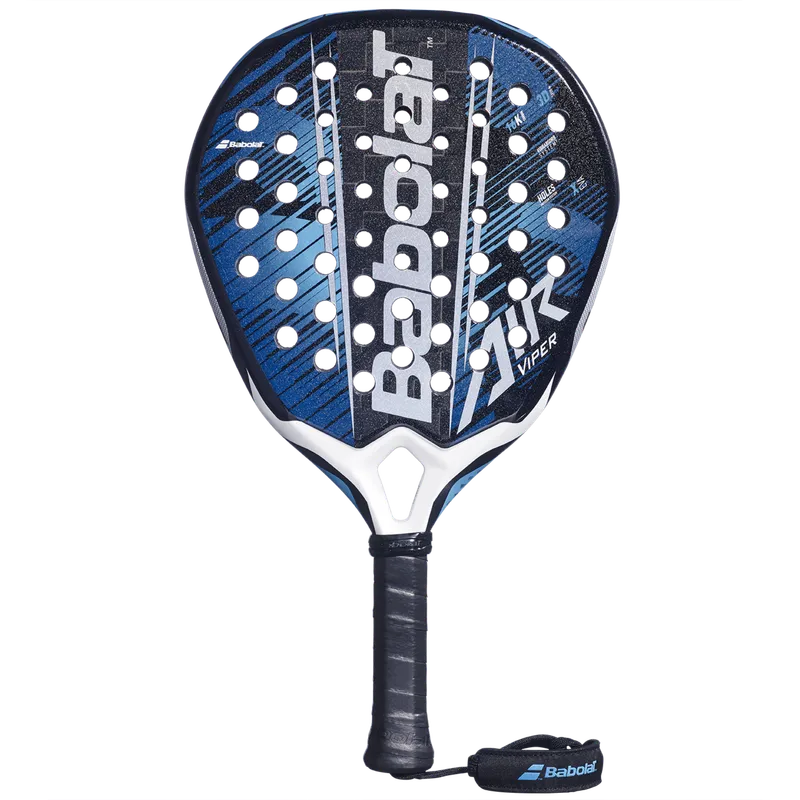
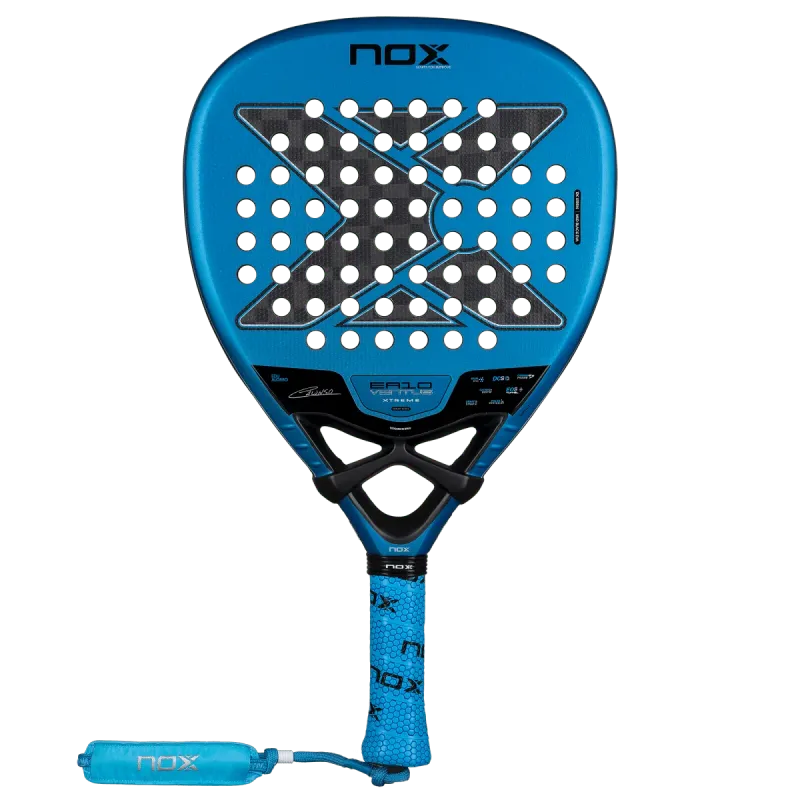
The Babolat Air Viper 2.6 2026 is a maneuverable power racket suited for advanced allrounders who rely on speed at the net, while the NOX EA10 Ventus Attack 12K Xtrem Edu Alonso is a heavier option designed for pro-level attackers looking to maximize output on aggressive shots. In our assessment, both rackets rate a 4 out of 5 for power versus control with small sweet spots, but their differing weights and target profiles define how they perform on court.
| Feature | Babolat Air Viper 2.6 2026 | NOX EA10 Ventus Attack 12K Xtrem Edu Alonso |
|---|---|---|
| Season | 2026 | Not stated |
| Racket Shape | Diamond (our assessment) | Diamond |
| Weight | 355 g | 360–375 g |
| Thickness | 38 mm | Not stated |
| Frame Material | Carbon | Not stated |
| Face Material | Carbon 16K | Carbon Fiber 12K Xtrem |
| Core Material | X-EVA | Not stated |
| Player Level | Advanced (our assessment) | Pro |
| Core Hardness | Medium (our assessment) | Not stated |
| Power vs Control | 4 / 5 (our assessment) | 4 / 5 (our assessment) |
| Sweet Spot | Small (our assessment) | Small (our assessment) |
| Player Profile | Allrounder (our assessment) | Attacker (our assessment) |
Which one has more power?
In our assessment, both models are heavily weighted toward offensive play, scoring a 4 out of 5 on our power versus control scale. However, the way each racket generates force differs based on its weight and physical makeup.
The NOX EA10 Ventus Attack 12K Xtrem Edu Alonso brings a higher weight range of 360–375 g combined with a diamond shape stated by the manufacturer. This additional mass behind the ball allows aggressive players to generate high levels of momentum on overheads like smashes and deep viboras. Because the core material, frame, and thickness are not stated by the manufacturer, the mechanical output relies heavily on its mass and diamond geometry.
The Babolat Air Viper 2.6 2026 features a lower static weight of 355 g, a 38 mm thickness, a carbon frame, an X-EVA core, and a Carbon 16K face. In our assessment, it also has a diamond shape. Rather than relying on heavy mass, it produces power through rapid head speed. Players who like to whip the racket through the air quickly during fast net duels or quick bandejas will find it easy to accelerate, though it offers less raw mass behind heavy smashes than the NOX model.
Which is easier to play and defend with?
Neither racket is designed to be an easy-going control option. In our assessment, both rackets feature a small sweet spot, meaning players must hit clean, centered shots to avoid loss of depth or precision.
Defending off the glass requires distinct handling for each frame. The Babolat Air Viper 2.6 2026 is noticeably lighter at 355 g. In defensive scenarios at the back of the court, this lower weight helps players get the racket face into position faster when under pressure. Its medium core hardness (in our assessment) and X-EVA core provide structured feedback on lob attempts, though off-center hits will still be punished by the small sweet spot.
The NOX EA10 Ventus Attack 12K Xtrem Edu Alonso is heavier at 360–375 g, which requires greater physical strength to maneuver rapidly when defending low wall bounces or blocking fast body shots. Because its core hardness, thickness, and frame material are not stated, we cannot evaluate its internal ball output on touch shots, but its weight profile makes it better suited for players who already possess strong arm technique and stability.
Who should buy which?
Choose the Babolat Air Viper 2.6 2026 if you:
- Are an advanced player seeking a fast, maneuverable power frame.
- Identify as an allrounder who transitions frequently between back-court defense and quick net attacks.
- Prefer a lighter 355 g setup with Carbon 16K faces and an X-EVA core for fast racket acceleration.
- Want a diamond shape (in our assessment) that remains manageable during fast reactions at the net.
Choose the NOX EA10 Ventus Attack 12K Xtrem Edu Alonso if you:
- Are a pro-level player who benefits from extra racket mass on offensive shots.
- Play as a dedicated attacker, especially on the left side, prioritizing overhead power like aggressive smashes and bandejas.
- Prefer a diamond shape straight from the manufacturer with a Carbon Fiber 12K Xtrem build.
- Possess the arm strength and conditioning required to handle a heavier weight range of 360–375 g.
Frequently asked questions
What player level is recommended for these rackets?
For the NOX EA10 Ventus Attack 12K Xtrem Edu Alonso, the manufacturer states it is built for pro players. The manufacturer does not state a player level for the Babolat Air Viper 2.6 2026, but in our assessment, it is best suited for advanced players due to its small sweet spot and power focus.
What are the main face material differences?
The Babolat Air Viper 2.6 2026 uses a Carbon 16K face over an X-EVA core and carbon frame. The NOX EA10 Ventus Attack 12K Xtrem Edu Alonso utilizes Carbon Fiber 12K Xtrem on the face, while its core and frame materials are not stated.
Which racket is lighter?
The Babolat Air Viper 2.6 2026 is lighter, coming in at a fixed weight of 355 g. The NOX EA10 Ventus Attack 12K Xtrem Edu Alonso is heavier, ranging between 360 g and 375 g.