

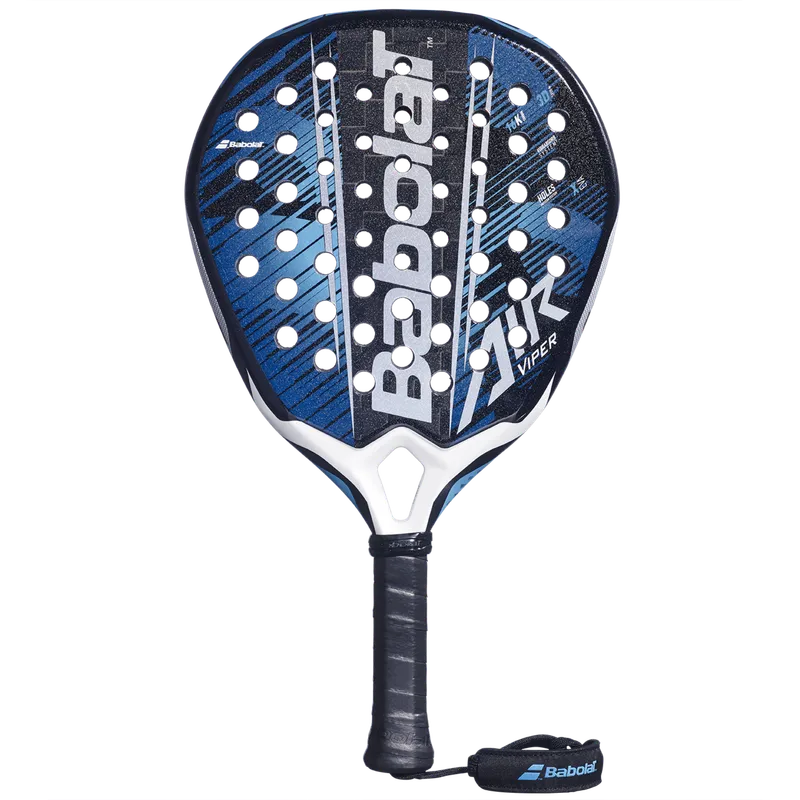
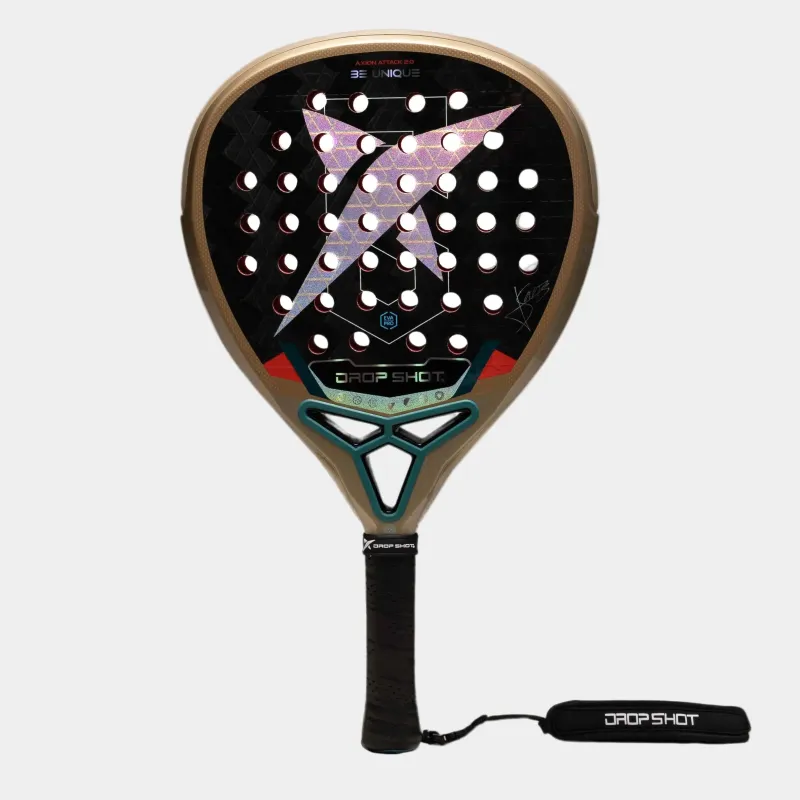
The Babolat Air Viper 2.6 2026 is tailored for advanced allrounders who want an offensive diamond-shaped racket with a medium core and precise handling. Meanwhile, the Drop Shot Axion Attack 2.0 2026 suits aggressive, pro-level attack players seeking a high-balance teardrop design with a hard core for high-density hitting power. Both rackets achieve a 4 out of 5 on our power-versus-control scale, but they deliver that power through distinctly different structural profiles and overall feel.
| Feature / Spec | Babolat Air Viper 2.6 2026 | Drop Shot Axion Attack 2.0 2026 |
|---|---|---|
| Season | 2026 | 2026 |
| Shape | Diamond (our assessment) | Teardrop (manufacturer) |
| Balance | Not stated | High (manufacturer) |
| Weight | 355 g (manufacturer) | 350–370 g (manufacturer) |
| Thickness | 38 mm (manufacturer) | Not stated |
| Face Material | Carbon 16K | Carbono 24K Twill Textreme |
| Frame Material | Carbon | Doble Tubular Carbono |
| Core Material | X-EVA | Eva Pro High Density |
| Core Hardness | Medium (our assessment) | Hard (our assessment) |
| Power vs Control | 4 / 5 (our assessment) | 4 / 5 (our assessment) |
| Sweet Spot | Small (our assessment) | Medium (our assessment) |
| Target Level | Advanced (our assessment) | Pro (manufacturer) |
| Player Type | Allrounder (our assessment) | Attacker (our assessment) |
Which racket offers more power on overheads?
When looking at offensive output, both rackets rate 4 out of 5 on our power-versus-control scale, but they generate that power through different characteristics. The Babolat Air Viper 2.6 features Carbon 16K faces combined with an X-EVA core and a diamond shape in our assessment. This structure provides direct force on full-extension smashes and aggressive viboras, provided you strike cleanly inside its small sweet spot (our assessment).
The Drop Shot Axion Attack 2.0 uses Carbono 24K Twill Textreme faces paired with an Eva Pro High Density core, which we rate as hard. Combined with its manufacturer-stated high balance and teardrop shape, the Drop Shot provides significant leverage and weight behind the ball during flat smashes and kick smashes. Players who prefer a firm, stiff response at impact will likely find the Drop Shot’s hard core and high balance extra impactful, while those who want an explosive overhead without an extra-hard feel may prefer the Babolat's medium core.
Which racket is easier to play and defend with?
Defending off the glass and managing fast-paced transition play highlights key trade-offs between these two frames. The Babolat Air Viper 2.6 weighs a fixed 355 g with a 38 mm thickness, giving it an agile feel for quick reactions at the net or when blocking incoming shots. However, in our assessment, its sweet spot is small, meaning off-center hits behind the baseline require precise footwork and clean execution.
In contrast, the Drop Shot Axion Attack 2.0 offers a medium sweet spot in our assessment, providing slightly more margin for error on off-center hits. However, its high balance and weight range of 350–370 g, combined with a hard core, require good wrist strength and technique when digging out low balls off the back glass or executing delicate lobs. In terms of arm comfort, the Babolat’s medium core offers moderate shock absorption, whereas the Drop Shot’s hard core yields a stiffer feel that provides direct feedback but less arm damping on mis-hits.
How do their materials and constructions differ?
The frame and face constructions highlight two distinct engineering approaches. The Babolat Air Viper 2.6 combines a Carbon frame with Carbon 16K faces and a multi-density X-EVA core. Manufacturer details for balance and shape are not stated for the Babolat, though in our assessment it features a diamond shape.
The Drop Shot Axion Attack 2.0 utilizes a Doble Tubular Carbono frame for structural rigidity, topped with Carbono 24K Twill Textreme on the faces and an Eva Pro High Density core. Manufacturer thickness is not stated for the Drop Shot. The 24K carbon weave on the Drop Shot paired with a hard core produces a very solid, high-density striking surface, while the Babolat's 16K carbon face and medium X-EVA core balance stiffness with core compliance.
Who should buy which?
Babolat Air Viper 2.6 2026
- Advanced allrounders who want power from a diamond-shaped frame in our assessment.
- Left or right-court players looking for a predictable 355 g frame weight with a standard 38 mm thickness.
- Players who prefer a medium core hardness for a balanced feel on overheads and volleys.
- Experienced players comfortable with a small sweet spot that demands precise hitting.
Drop Shot Axion Attack 2.0 2026
- Pro-level attackers looking for high power and high balance in a teardrop shape.
- Left-court aggressive players who rely on hard contact for aggressive smashes and fast bandejas.
- Players who want a hard core feel combined with a medium sweet spot for controlled offensive play.
- Padel players seeking high-density carbon faces (24K Twill Textreme) and structural double-tubular carbon framing.
Frequently asked questions
Which racket is better for an aggressive attacker?
In our assessment, the Drop Shot Axion Attack 2.0 is specifically tailored for attackers, combining a high balance, teardrop shape, and hard core to maximize power on overheads. The Babolat Air Viper 2.6 also offers strong power with a rating of 4 out of 5 on our scale, but we categorize it for advanced allrounders who need versatility across all court zones.
What are the core hardness differences between these two models?
In our assessment, the Babolat Air Viper 2.6 features a medium core hardness from its X-EVA core, offering a balance of ball output and control. The Drop Shot Axion Attack 2.0 features an Eva Pro High Density core, which we rate as hard, giving a stiffer impact feel suited for players who prefer direct energy transfer.
What are the sweet spot sizes for each frame?
In our assessment, the Babolat Air Viper 2.6 has a small sweet spot that rewards precise ball striking, whereas the Drop Shot Axion Attack 2.0 features a medium sweet spot that offers a bit more forgiveness on off-center contact.