

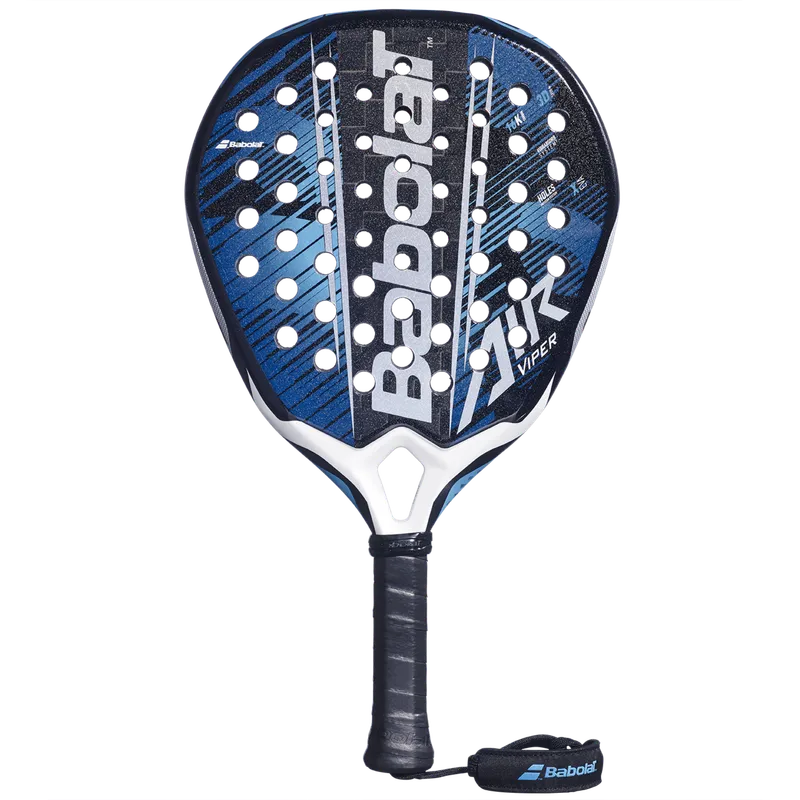
The Babolat Air Viper 2.6 2026 is designed for advanced allround players who want an offensive edge with significant power at the net. Meanwhile, the Bullpadel Ionic Control 26 is tailored for advanced strategic builders and counter-attackers who require maximum precision and defensive reliability. Your choice depends on whether you prefer attacking power for overheads or steady control to dictate rallies from the back of the court.
Key specifications comparison
| Feature | Babolat Air Viper 2.6 2026 | Bullpadel Ionic Control 26 |
|---|---|---|
| Season | 2026 | Not stated |
| Shape | Diamond (our assessment) | Round |
| Balance | Not stated | Low |
| Weight | 355 g | 365–375 g |
| Profile Thickness | 38 mm | Not stated |
| Frame Material | Carbon | Carbon + Fiberglas |
| Face Material | Carbon 16K | Not stated |
| Core | X-EVA | Dual |
| Player Level | Advanced (our assessment) | Advanced |
| Core Hardness | Medium (our assessment) | Medium (our assessment) |
| Power vs Control | 4 / 5 (our assessment) | 1 / 5 (our assessment) |
| Sweet Spot | Small (our assessment) | Large (our assessment) |
| Player Profile | Allrounder (our assessment) | Builder, Counter (our assessment) |
Which one has more power?
When comparing offensive capability, the Babolat Air Viper 2.6 2026 holds a clear advantage. In our assessment, we rate the Air Viper 2.6 2026 at a 4 out of 5 on the power-versus-control scale, leaning strongly toward power. This performance is driven by its Carbon frame, Carbon 16K face, and X-EVA core, combined with a diamond shape in our assessment. These technical elements help generate high ball speed on aggressive net plays, high-impact smashes, and fast viboras.
On the other hand, the Bullpadel Ionic Control 26 sits at the opposite end of the spectrum. In our assessment, we rate it at a 1 out of 5, placing it squarely in the pure control category. The manufacturer features a dual core, a hybrid Carbon + Fiberglas frame, and a low balance. While this setup ensures exceptional placement, it delivers minimal automatic power. Players attempting to finish points with overhead smashes using the Ionic Control 26 must rely almost entirely on their own physical force and technique.
Which is easier to play and defend with?
For defensive play and court management, the Bullpadel Ionic Control 26 is significantly more forgiving. The manufacturer specifies a round shape and low balance, while in our assessment, it features a large sweet spot. These properties make it remarkably effective when defending off the glass, executing delicate chiquitas, or launching precise defensive lobs under pressure. The low balance keeps the racket feeling stable during rapid exchanges at the net, making it an excellent tool for left- or right-side counter-attackers who absorb opponents' heavy shots.
Conversely, the Babolat Air Viper 2.6 2026 requires higher technical precision during defensive situations. In our assessment, its diamond shape and small sweet spot offer less tolerance for off-center contact. If you miss the sweet spot when returning difficult wall bounces or hit a late bandeja, the shot can lose depth or accuracy. However, its lighter weight of 355 g allows for fast handling, which aids quick reflexes during net battles.
How do materials and build compare?
The technical builds of these two models cater to vastly different playing demands. The Babolat Air Viper 2.6 2026 incorporates a Carbon frame and a Carbon 16K face, providing a firm response. Its X-EVA core and standard 38 mm profile thickness contribute to its structural firmness, which aligns with its medium core hardness in our assessment. Babolat lists its official season as 2026, while its balance is not stated.
The Bullpadel Ionic Control 26 mixes materials by combining Carbon and Fiberglas in the frame, paired with a dual core. The manufacturer does not state the face material, profile thickness, or season for this racket. Weighing 365–375 g, it is heavier than the 355 g Babolat model, but its low balance balances out the overall mass. In our assessment, both rackets share a medium core hardness, though their structural balance and sweet spot sizes create completely distinct playing experiences. Specific arm comfort technologies are not stated by either manufacturer.
Who should buy which?
Choose the Babolat Air Viper 2.6 2026 if you:
- Are an advanced allround player looking for higher power (rated 4 out of 5 in our assessment).
- Enjoy an aggressive playing style focused on powerful smashes, deep viboras, and fast volleys at the net.
- Prefer a lighter racket weighing 355 g with a Carbon 16K face construction.
- Can handle a small sweet spot and diamond shape (in our assessment) without sacrificing shot consistency.
Choose the Bullpadel Ionic Control 26 if you:
- Are an advanced game builder or counter-attacker seeking pure control (rated 1 out of 5 in our assessment).
- Prioritize deep defensive play, precise wall returns, and high consistency from the back of the court.
- Prefer a round racket shape with a low balance and a large sweet spot (in our assessment) for increased forgiveness.
- Favor a frame built with Carbon and Fiberglas weighing between 365 g and 375 g.
Frequently asked questions
What player levels are these rackets suitable for?
Bullpadel explicitly specifies the Ionic Control 26 for advanced players. Babolat does not state the official target player level for the Air Viper 2.6 2026, but in our assessment, it is also best suited for advanced players.
What is the power versus control rating for each racket?
In our assessment, we rate the Babolat Air Viper 2.6 2026 at a 4 out of 5 (power-oriented), whereas we rate the Bullpadel Ionic Control 26 at a 1 out of 5 (pure control).
What are the shape and sweet spot differences between the two models?
Bullpadel states that the Ionic Control 26 has a round shape, and in our assessment, it features a large sweet spot. Babolat does not state the official shape, but in our assessment, the Air Viper 2.6 2026 features a diamond shape with a small sweet spot.