

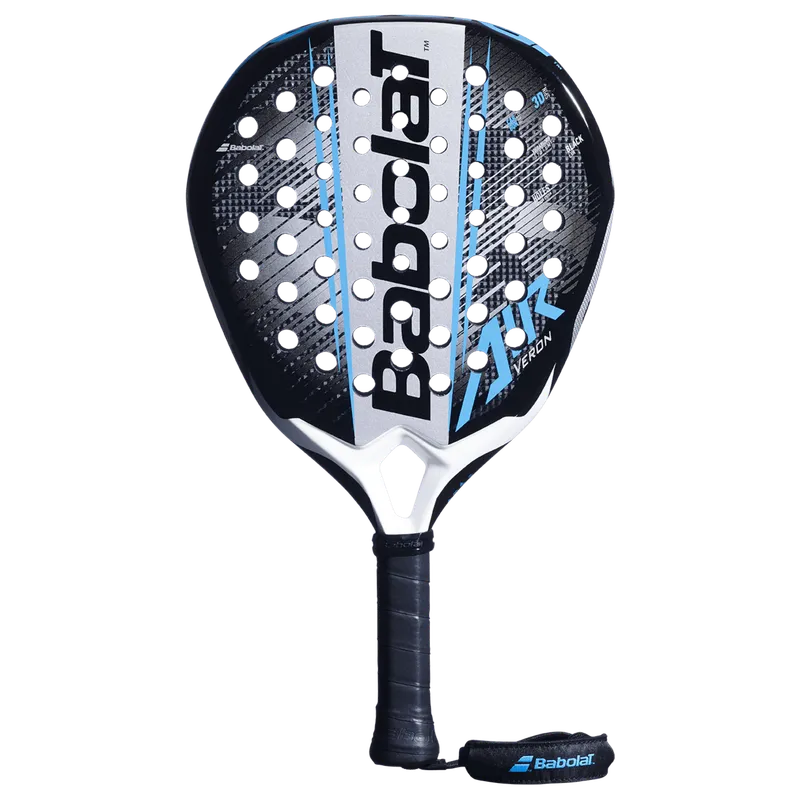
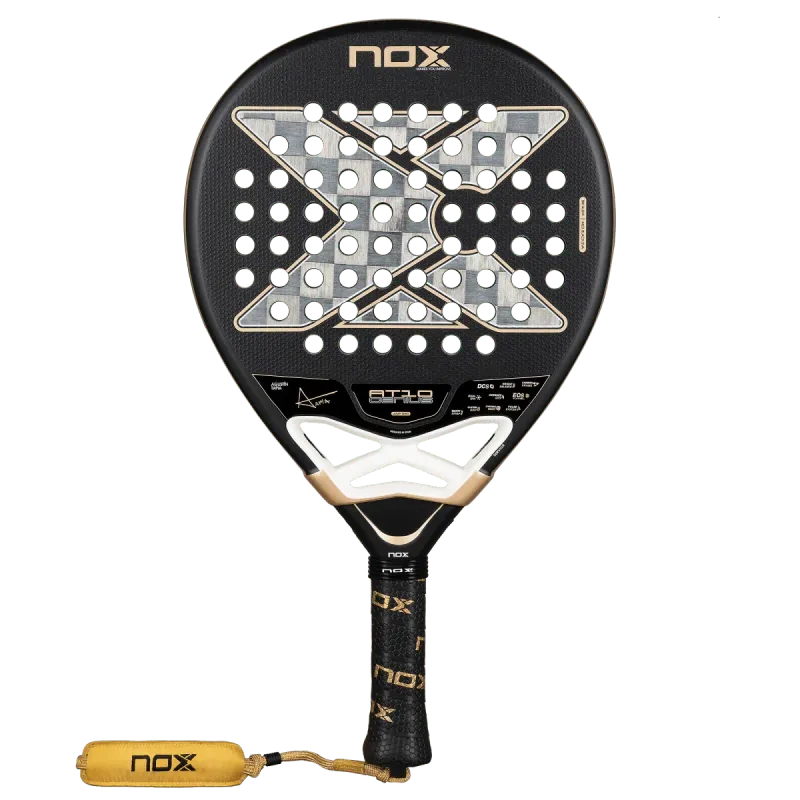
The Babolat Air Veron 2.6 2026 delivers a lightweight 355 g build designed for advanced all-round players who prioritize swift movement at the net. The NOX AT10 Luxury Genius 18K Alum Agustín Tapia 2026 features a heavier 360–375 g build suited for pro-level all-rounders looking for more physical mass behind their shots. While both rackets achieve a balanced touch with a medium core hardness in our assessment, the choice comes down to whether you prefer lightweight agility or additional racket mass.
| Feature | Babolat Air Veron 2.6 2026 | NOX AT10 Luxury Genius 18K Alum Agustín Tapia 2026 |
|---|---|---|
| Season | 2026 | 2026 |
| Player Endorsement | Not stated | Agustín Tapia |
| Weight (manufacturer) | 355 g | 360–375 g |
| Thickness (manufacturer) | 38 mm | Not stated |
| Face Material (manufacturer) | Carbon Flex | Carbon Fiber 18K Alum |
| Frame Material (manufacturer) | Carbon | Not stated |
| Core Material (manufacturer) | Black EVA | MLD Black Eva |
| Player Level (manufacturer) | Not stated | Pro |
| Racket Shape (our assessment) | Hybrid | Teardrop |
| Target Level (our assessment) | Advanced | Not stated |
| Core Hardness (our assessment) | Medium | Medium |
| Power vs Control (our assessment) | 3 / 5 | 3 / 5 |
| Sweet Spot (our assessment) | Medium | Medium |
| Player Type (our assessment) | Allrounder | Allrounder |
Which racket offers better maneuverability and handling?
Handling is heavily dictated by overall weight. The Babolat Air Veron 2.6 2026 sits at 355 g, making it a distinctly lightweight option. This lower mass allows for faster reaction times during fast net exchanges, quick volleying, and rapid defensive adjustments off the glass. In our assessment, its hybrid shape further complements an energetic all-round playstyle.
In contrast, the NOX AT10 Luxury Genius 18K Alum Agustín Tapia 2026 is heavier, ranging between 360 g and 375 g. In our assessment, this racket has a teardrop shape. While the added weight requires more arm strength to maneuver quickly, it provides enhanced stability when blocking heavy opponent shots or controlling fast balls at the net.
Which one has more power or control?
In our assessment, both rackets rate 3 out of 5 on our power versus control scale, placing them squarely in the balanced all-round category. Neither model leans heavily toward pure power or pure control. Furthermore, both rackets feature a medium core hardness in our assessment, using Black EVA in the Babolat and MLD Black Eva in the NOX.
The structural differences lie in their construction materials and overall weight. The Babolat Air Veron 2.6 pairs a 38 mm carbon frame with a Carbon Flex face. Its lower weight allows players to generate rapid head speed for overhead shots like bandejas or viboras. The NOX features Carbon Fiber 18K Alum on the faces (its frame material and profile thickness are not stated by the manufacturer). The extra static mass of the NOX helps transfer momentum directly into flat smashes, giving players who can handle the heavier frame solid driving power.
Which is easier to play?
In our assessment, both models feature a medium sweet spot, meaning neither racket is specifically engineered with an oversized margin for error. They are both built for experienced players. The NOX AT10 is explicitly classified by its manufacturer for pro players, while in our assessment, the Babolat Air Veron 2.6 is aimed at advanced players (its manufacturer player level is not stated).
The Babolat Air Veron 2.6 2026 may prove easier to handle over long matches simply due to its lighter weight of 355 g, putting less strain on the arm during repetitive overhead shots. The NOX AT10 Luxury Genius requires solid physical condition and technique to consistently swing its 360–375 g mass without fatigue.
Who should buy which?
Babolat Air Veron 2.6 2026 is best for:
- Advanced all-round players seeking a lightweight 355 g racket for quick arm speed.
- Players who prioritize rapid court movement, fast net volleys, and quick reactions off the glass.
- Players looking for a hybrid shape constructed with a carbon frame and Carbon Flex faces.
NOX AT10 Luxury Genius 18K Alum Agustín Tapia 2026 is best for:
- Pro-level all-round players wanting to play with Agustín Tapia's signature model.
- Players who prefer a heavier setup (360–375 g) for added punch behind aggressive volleys and smashes.
- Players seeking a teardrop shape with Carbon Fiber 18K Alum faces and an MLD Black Eva core.
Frequently asked questions
What are the main physical differences between these two models?
The Babolat Air Veron 2.6 2026 weighs 355 g, has a 38 mm thickness, a carbon frame, and a Carbon Flex face, with a hybrid shape in our assessment. The NOX AT10 Luxury Genius 18K Alum 2026 weighs between 360 g and 375 g and features Carbon Fiber 18K Alum faces with a teardrop shape in our assessment. The frame material and thickness of the NOX model are not stated.
How do the cores of these rackets compare?
Babolat uses a Black EVA core, whereas NOX utilizes an MLD Black Eva core. In our assessment, both cores deliver a medium hardness, resulting in a balanced feel suited for all-round performance.
Are these rackets suitable for intermediate players?
NOX targets pro-level players according to manufacturer specifications, while we assess the Babolat as suitable for advanced players. Because both rackets feature a medium sweet spot in our assessment and require refined mechanics, they are better suited for advanced and professional players rather than beginners or early intermediates.