

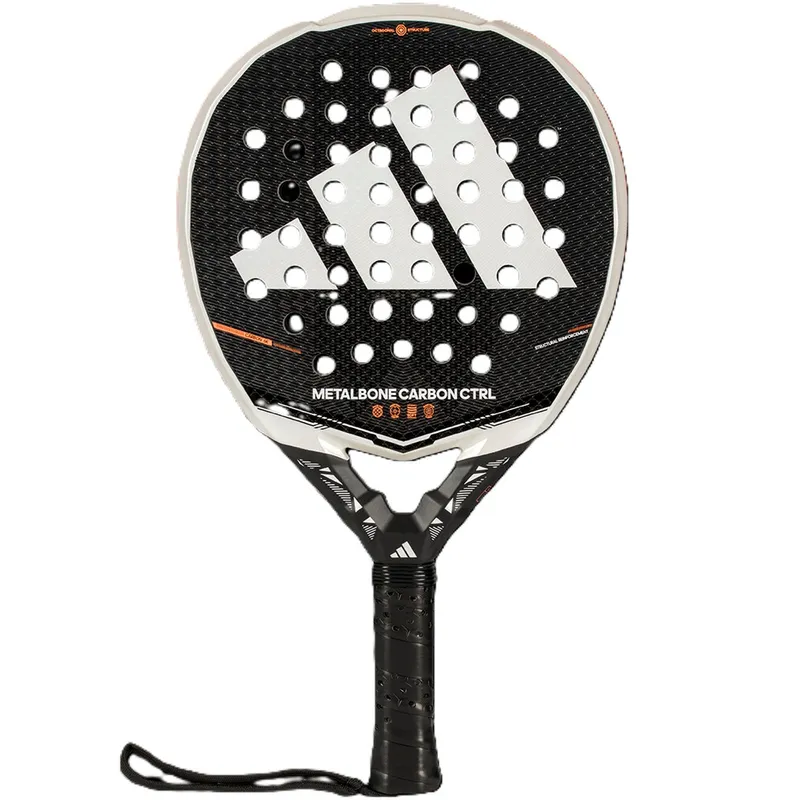
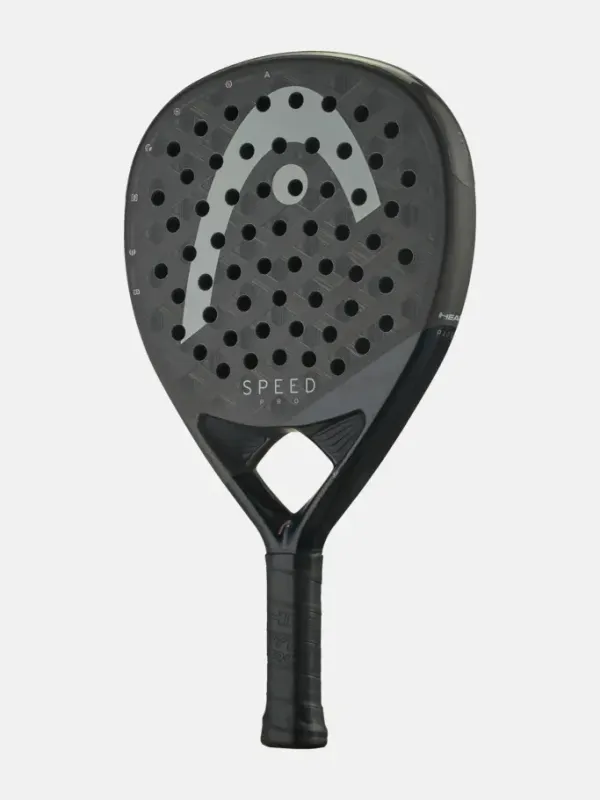
The adidas Metalbone Carbon CTRL 3.5 is tailored for advanced tactical builders who prioritize control, maneuverability, and a forgiving response. Conversely, the Head Speed Pro 2025 targets advanced aggressive attackers seeking higher power output from a head-heavy distribution. Choosing between them comes down to whether your role on the court demands defensive precision or net-dominating overheads.
| Spec / Feature | adidas Metalbone Carbon CTRL 3.5 | Head Speed Pro 2025 |
|---|---|---|
| Manufacturer Shape | Round | Not stated |
| Shape (our assessment) | Round | Teardrop |
| Manufacturer Balance | Even | High |
| Weight | 365 g | 370 g |
| Frame Material | Carbon 6K | Not stated |
| Face Material | Not stated | Hybrid Woven |
| Core Material | Soft | Power Foam |
| Manufacturer Level | Advanced | Not stated |
| Level (our assessment) | Advanced | Advanced |
| Core Hardness (our assessment) | Soft | Soft |
| Power vs Control (our assessment) | 2 / 5 (Control-oriented) | 4 / 5 (Power-oriented) |
| Sweet Spot (our assessment) | Large | Medium |
| Player Type (our assessment) | Builder | Attacker |
| Release Season | Not stated | 2025 |
Which one has more power?
When evaluating raw power output for offensive play, the Head Speed Pro 2025 holds a clear edge. Featuring a high balance stated by the manufacturer and a overall weight of 370 g, it naturally generates more leverage on overhead swings. In our assessment, we rate its power versus control profile at a 4 out of 5, placing it firmly in the attacker category. Players executing aggressive smashes or driving heavy viboras will find the head-heavy mass of the Head Speed Pro 2025 effective for finishing points.
By contrast, the adidas Metalbone Carbon CTRL 3.5 is designed around precision rather than high-end power. It features an even balance paired with a slightly lighter weight of 365 g. In our assessment, we rate its power versus control at 2 out of 5. While its soft core provides decent ball output on moderate swings, it does not offer the same top-heavy inertia required to maximize smash speed.
Which is easier to play and control?
For consistency and defensive ease, the adidas Metalbone Carbon CTRL 3.5 is the more accessible option. Its round shape, even balance, and 365 g weight make it easy to maneuver when reactively defending deep in the court. In our assessment, it features a large sweet spot, offering greater forgiveness on off-center hits when scrambling off the back glass. The combination of an even balance and soft core allows point builders to construct rallies with accurate lobs and controlled bandejas.
The Head Speed Pro 2025 is more demanding during quick defensive exchanges. In our assessment, its shape is teardrop and its sweet spot is medium. Combined with its 370 g weight and high balance, it requires reliable physical preparation and precise contact, particularly when defending fast shots off the glass or attempting fast reaction volleys at the net.
How do the trade-offs affect game situations?
The structural differences between these two frames dictate how they perform across specific padel situations:
- Defending off the glass: The adidas Metalbone Carbon CTRL 3.5 excels in defensive positions. Its 365 g weight and even balance allow for fast racket preparation, while the large sweet spot (in our assessment) helps absorb fast wall bounces to reset the point safely. The Head Speed Pro 2025 requires more physical effort to handle near the back glass due to its 370 g weight and high balance.
- Net play and overheads: At the net, the Head Speed Pro 2025 comes into its own. The high balance adds punch to attacking volleys and helps put away ball opportunities with powerful smashes. The adidas model offers steady directional control for placing volleys into open spaces, but it cannot generate the same natural depth on power overheads.
- Arm comfort and physical demand: Both models feature soft core properties—the adidas uses a soft core, while the Head utilizes Power Foam (both rated by us as having soft core hardness). However, the adidas Metalbone Carbon CTRL 3.5 is generally less physically demanding over long matches due to its lighter weight and even balance, making it easier on the arm.
Who should buy which?
adidas Metalbone Carbon CTRL 3.5
- Control-oriented builders: Ideal for right-side players who focus on constructing rallies, defensive resets, and placement.
- Players prioritizing maneuverability: Great for advanced players who prefer an even-balanced, 365 g frame that moves quickly in defense.
- Players seeking forgiveness: Best suited for those who benefit from a large sweet spot (in our assessment) to maintain match consistency.
Head Speed Pro 2025
- Aggressive attackers: Ideal for left-side players who demand extra power on smashes, viboras, and aggressive volleys.
- Players comfortable with head-heavy frames: Suited for advanced players capable of managing a 370 g weight with a high balance.
- Teardrop profile users: Designed for players looking for an aggressive teardrop shape (in our assessment) paired with Power Foam.
Is the Head Speed Pro 2025 suitable for defensive players?
While playable across all court zones, in our assessment the Head Speed Pro 2025 is geared toward attackers (rating 4 out of 5 on our power scale) due to its high balance and 370 g weight.
Which racket has a larger sweet spot?
In our assessment, the adidas Metalbone Carbon CTRL 3.5 features a large sweet spot paired with its round shape, whereas the Head Speed Pro 2025 has a medium sweet spot.
What core materials do these rackets use?
The adidas Metalbone Carbon CTRL 3.5 features a soft core, while the Head Speed Pro 2025 uses Power Foam. In our assessment, both cores deliver a soft core hardness profile.